
Enterprises are racing to embed AI into their core workflows—but integration, governance, and performance remain roadblocks.
In this article, I explore how Anthropic’s Claude 3.7 Sonnet, now natively available in Azure Databricks, enables secure, no-code AI agents that transform enterprise operations across industries.
Partnership at a Glance
On March 26, 2025, Anthropic and Azure Databricks announced a strategic collaboration to reshape enterprise AI. Claude 3.7 Sonnet, Anthropic’s most advanced model, is now embedded into the Azure Databricks Data Intelligence Platform.
This integration allows over 10,000 organizations to develop AI agents that reason, automate, and scale—all within their existing analytics workflows. By combining Claude’s intelligence with Databricks’ unified platform, enterprises can unlock real-time insights and deploy domain-specific agents without relying on external tools or complex infrastructure.
Inside Claude 3.7 Sonnet
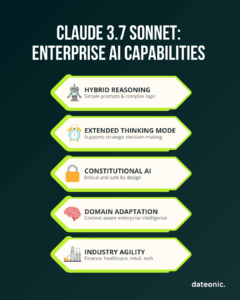
Claude 3.7 Sonnet, launched in February 2025, represents a major leap in enterprise AI capabilities. Built for hybrid reasoning, it balances speed and depth—providing instant answers to simple prompts while also delivering multi-step logic for complex tasks like fraud detection, code generation, and strategy forecasting.
Its “extended thinking mode” supports nuanced problem-solving, making it especially valuable for high-stakes applications across finance, operations, and product development. Designed with Constitutional AI principles, Claude also prioritizes ethical outputs and enterprise-grade safety.
Why Azure Databricks?
What sets this integration apart is its seamless, in-platform experience. Claude runs natively within Azure Databricks, eliminating the need for data movement, third-party orchestration, or custom APIs. Enterprises can connect Claude directly to live business data—sales logs, IoT signals, financial records—inside a secure and governed workspace.
This architecture avoids the fragmentation seen in platforms like Snowflake or Amazon Redshift, offering tighter control, faster deployment, and a truly unified AI-analytics workflow.
If you’re weighing platform choices, explore our Databricks vs Azure Databricks comparison to understand key differences in governance, integration, and enterprise readiness.
| Feature | Azure Databricks + Claude | Snowflake + LLMs | Redshift + Bedrock |
|---|---|---|---|
| Integration | ✅ Native | ❌ External | ⚠️ Partial |
| Data Movement | ❌ None | ✅ Required | ✅ Required |
| Governance | ✅ Unity Catalog | ⚠️ Manual | ⚠️ Manual |
| Real-Time Analytics | ✅ Built-in | ⚠️ Slower | ⚠️ Redshift-only |
| No-Code Tools | ✅ Visual + SQL | ⚠️ Dev-focused | ⚠️ Limited |
| Custom Models | ✅ RAG + Lakehouse | ⚠️ Extra tooling | ⚠️ Basic only |
Key Benefits
- Advanced AI Capabilities: Claude’s reasoning and coding prowess enable AI agents to tackle tasks like fraud detection or supply chain optimization with high accuracy, leveraging Databricks’ workflows for automation.
- Robust Governance: Unity Catalog provides end-to-end monitoring, tracking data access to meet compliance standards like GDPR or HIPAA. Enterprises must set policies to prevent unauthorized data extraction, ensuring security.
- Model Flexibility: Users can select from multiple AI providers, including Anthropic, and customize models with enterprise data for tailored solutions, enhancing versatility.
- No-Code Accessibility: Non-technical users can leverage Claude’s no-code interfaces, democratizing AI for teams across finance, marketing, or operations.
Real-World Applications
The partnership supports diverse industries:
- Finance: Banks can analyze transactions for fraud or generate investment insights, similar to Databricks’ fintech fraud prevention tactics.
- Healthcare: Providers can process medical data for diagnostics or personalized care plans, transforming healthcare data into actionable insights.
- Retail: Retailers can forecast demand or personalize customer experiences.
- Technology: Developers can use Claude Code to write and debug code faster, boosting productivity.
For example, a hypothetical retailer might use Claude to analyze sales data, potentially increasing revenue by 10-15% through optimized promotions, though outcomes vary by implementation.
Governance and Security
Unity Catalog ensures secure data handling, but enterprises must define when data extraction is appropriate to avoid compliance risks, addressing governance concerns. This makes it one of the best platforms for protecting sensitive data. Claude’s Constitutional AI adds safety guardrails, preventing unethical outputs.
Transforming Enterprise AI
This partnership sets a new benchmark for enterprise AI. By combining Anthropic’s Claude 3.7 Sonnet with Azure Databricks’ robust platform, businesses can drive efficiency, innovation, and growth. The integration particularly shines when compared to other solutions like Azure Fabric due to its comprehensive AI capabilities.
Interested in exploring how this integration can benefit your organization? Contact our experts to learn more about implementing Databricks’ Lakehouse Architecture with Claude AI.