
Your Databricks investment’s ROI hinges entirely on your implementation partner. But with over 5,000 partners in a crowded market, how do you separate genuine expertise from clever marketing?
This 10-point checklist is a practical vetting system designed to cut through the noise. Use it to move beyond sales pitches and evaluate potential partners on what truly matters: a proven track record, measurable outcomes, and the ability to deliver tangible business value.
Understanding Databricks Partner Types and Tiers
Databricks partners are categorized to help you find the right fit for your needs. The main categories are:
- Consulting & SI (System Integrators): These partners, like Dateonic, focus on the implementation, migration, and scaling of Databricks solutions.
- Technology: These partners offer integrations that complement the Databricks platform.
- Cloud Providers: Databricks is available on major cloud platforms like AWS, Azure, and GCP.
Partners are also organized into tiers, which indicate their level of expertise and commitment to the Databricks platform:
| Tier | Characteristics | Strengths |
|---|---|---|
| Elite | 200+ certifications, proven success, awards | Deep expertise, extensive experience, and a strong relationship with Databricks. |
| Select | Specialized expertise in a particular area or industry. | In-depth knowledge of specific use cases and industries. |
Tip: Start your search by using the official Databricks Partner Directory to shortlist potential partners.
Preparing Your Requirements Before Deciding How to Choose a Databricks Partner
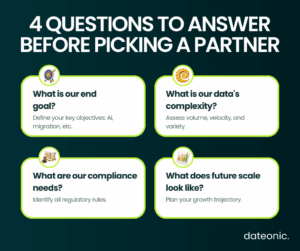
Before you start evaluating partners, it’s essential to define your project’s goals and requirements. This will help you find a partner with the right expertise for your specific needs.
Key considerations include:
- Project Goals: Are you migrating a legacy system, deploying an AI model, or implementing a data governance framework?
- Data Volume and Complexity: What is the scale of your data, and what are the specific challenges you face?
- Industry Regulations: Are there any compliance or regulatory requirements that need to be addressed?
- Scalability Needs: What are your future growth plans, and how will your Databricks platform need to scale to support them?
The 10-Point Checklist: Key Criteria for How to Choose a Databricks Partner
Use this checklist to evaluate potential Databricks partners and ensure you make an informed decision:
- Verify Official Databricks Partnership Status:
- Why it matters: An official partnership ensures the partner has endorsed access to Databricks tools, support, and training.
- Questions to ask: “Are you listed in the official Databricks Partner Directory?”
- Check Databricks Certifications and Team Expertise:
- Why it matters: A team with certified data engineers and champions demonstrates a high level of proficiency with the Databricks platform, including key features like Unity Catalog.
- Questions to ask: “How many certified Databricks professionals are on your team?” “Can you share examples of your team’s expertise?”
- Evaluate Proven Track Record with Measurable Case Studies:
- Why it matters: Case studies with clear ROI metrics provide evidence of the partner’s ability to deliver tangible business value.
- Questions to ask: “Can you provide case studies with measurable outcomes, such as cost savings or efficiency gains?” For an example of a detailed case study, see how Dateonic helped a client achieve 9.3% efficiency gains in logistics.
- Assess Industry-Specific Knowledge:
- Why it matters: A partner with experience in your industry will understand your unique challenges and be better equipped to provide tailored solutions.
- Questions to ask: “What is your experience in the [your industry] sector?” “Can you provide examples of how you’ve solved challenges for other companies in our industry?”
- Look for Comprehensive End-to-End Services:
- Why it matters: A partner that offers a full range of services, from strategy and implementation to training and optimization, can provide a seamless and integrated solution.
- Questions to ask: “Do you offer end-to-end services?” “What does your post-implementation support look like?”
- Review Client References and Testimonials:
- Why it matters: Direct feedback from previous clients is a powerful indicator of a partner’s reliability and the quality of their work.
- Questions to ask: “Can you provide client references that we can speak with?”
- Ensure Focus on ROI and Transparent Pricing:
- Why it matters: A partner focused on ROI will help you optimize costs and maximize the value of your Databricks investment. Transparent pricing ensures there are no hidden fees.
- Questions to ask: “How do you approach cost optimization?” “Can you provide a clear and detailed pricing structure?”
- Examine Community Contributions and Thought Leadership:
- Why it matters: A partner that is active in the Databricks community, through open-source contributions, meetups, blogs, or a YouTube channel, is likely to be at the forefront of innovation.
- Questions to ask: “How does your team contribute to the Databricks community?” “Where can we find your thought leadership content?” For more insights, check out the Dateonic Blog.
- Consider Cultural Fit and Communication Style:
- Why it matters: A good cultural fit and clear communication are essential for a successful and collaborative partnership.
- Questions to ask: “Can you describe your team’s communication and collaboration style?”
- Analyze Ongoing Support and Scalability:
- Why it matters: Your data and AI needs will evolve over time. A good partner will provide ongoing support and help you scale your Databricks platform as your business grows.
- Questions to ask: “What kind of ongoing support do you offer?” “How will you help us scale our Databricks implementation in the future?”
How to Evaluate and Select Your Databricks Partner
Once you have a shortlist of potential partners, follow these steps to make your final selection:
- Research: Use the Databricks Partner Directory and other resources to gather information about each partner.
- Issue RFPs (Requests for Proposals): Send a detailed RFP to your shortlisted partners, outlining your project goals and requirements.
- Interview: Meet with your top choices to discuss their proposals and ask them the questions from the checklist.
- Check References: Speak with their former clients to get honest feedback on their performance.
- Score: Use the following table to score each partner based on the 10-point checklist.
| Point | Notes | Score (1-10) |
|---|---|---|
| 1. Official Databricks Partnership Status | ||
| 2. Certifications and Team Expertise | ||
| 3. Proven Track Record with Measurable Case Studies | ||
| 4. Industry-Specific Knowledge | ||
| 5. Comprehensive End-to-End Services | ||
| 6. Client References and Testimonials | ||
| 7. Focus on ROI and Transparent Pricing | ||
| 8. Community Contributions and Thought Leadership | ||
| 9. Cultural Fit and Communication Style | ||
| 10. Ongoing Support and Scalability | ||
| Total Score |
Common Mistakes to Avoid When Learning How to Choose a Databricks Partner
- Opting for the cheapest partner: While cost is a factor, choosing a partner based solely on price can lead to poor quality and a lack of expertise.
- Ignoring industry fit: A partner that doesn’t understand your industry may not be able to provide the best solutions.
- Skipping references: References are a crucial step in the evaluation process and should not be overlooked.
For more information on Databricks you can also check the official Databricks blog.
Conclusion
By using this 10-point checklist, you can confidently choose a Databricks partner that is aligned with your business goals and has the expertise to help you succeed.
For a partner that excels in certifications, measurable case studies, and community contributions, contact Dateonic, an official Databricks consulting partner, at dateonic for a free consultation.