
Your AI strategy is destined to fail without a world-class data strategy to match. Yet as companies pour resources into artificial intelligence to gain a competitive edge, a dangerous gap is forming between their AI ambitions and the data governance meant to support them.
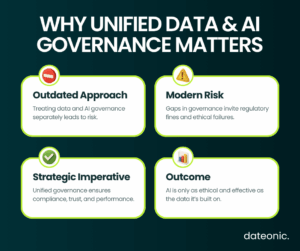
This isn’t just a technical oversight, it’s a direct path to regulatory fines, brand-damaging ethical crises, and operational chaos. The problem stems from an outdated approach: treating the rules for data as separate from the rules for the AI that consumes it.
In today’s landscape, that separation is a liability. A unified data and AI governance strategy is no longer a competitive advantage, it’s a fundamental requirement for survival and success.
What Is Unified Data and AI Governance
To understand the need for unification, we must first define the components. At its core, unified governance combines two critical disciplines into a single, cohesive strategy.
- Data Governance: The management of data availability, usability, and security to ensure it remains accurate, consistent, and protected.
- AI Governance: The policies and standards ensuring AI systems are developed and used responsibly, ethically, and in legal compliance.
The necessity of a unified approach becomes clear when you recognize that AI models are fundamentally dependent on the quality of the data they are trained on. A siloed strategy creates a dangerous gap.
Unified governance bridges this gap, ensuring that the principles of security and ethics are woven into the entire data-to-AI pipeline. This alignment is reinforced by technical practices like using a Change Data Feed (CDF) to maintain data integrity from the source.
The Critical Need for a Unified Approach
The theoretical benefits of unified governance translate into tangible, real-world advantages that modern enterprises cannot afford to ignore.
Navigating the Complex Regulatory Landscape
Organizations today operate under a growing web of regulations. A unified governance framework is the most effective way to ensure compliance across a complicated and evolving legal environment.
Key drivers include:
- Existing Data Privacy Laws: Complying with strict regulations on customer data, such as GDPR and CCPA.
- Emerging AI Legislation: Adapting to new laws like the EU AI Act, which specifically govern the use of AI.
Because these regulations treat data and AI as interconnected, a unified approach is necessary to create consistent, defensible compliance strategies and reduce the risk of costly penalties.
| Regulation / Law | Focus Area | Applies To | Why It Requires Unified Governance |
|---|---|---|---|
| GDPR (EU) | Data privacy | Personal data | AI systems using personal data must comply |
| CCPA (California) | Consumer rights | Customer data | Transparency and control required at all levels |
| EU AI Act | AI risk management | AI model development | Mandates clear governance for high-risk AI |
| HIPAA (US Healthcare) | Health data protection | Patient data and AI tools | Unified controls required for AI in diagnostics |
Building Ethical and Trustworthy AI
The conversation around ethical AI has moved from academia to the boardroom. An AI model that produces biased outcomes is often a symptom of biased data.
A unified governance framework tackles this problem at its root by embedding ethical checkpoints throughout the data lifecycle.
This helps an organization:
- Address Bias: Actively identifying and mitigating bias at the data source to prevent discriminatory outcomes.
- Ensure Fairness & Transparency: Setting clear standards for model behavior and maintaining auditable records for accountability.
This comprehensive oversight is essential for building AI systems that are trusted by customers, regulators, and the public.
Driving Operational Efficiency and Performance
Beyond risk mitigation, unified governance is a powerful driver of business efficiency. When high-quality, reliable data fuels your analytics initiatives, it leads to direct operational improvements, such as:
- Better Decision-Making: Generating more accurate insights from AI and analytics.
- Streamlined Processes: Reducing manual errors and automating repetitive work.
- Accelerated Timelines: Granting teams faster access to reliable, ready-to-use data.
By implementing effective data pipeline strategies, businesses can significantly boost their analytical capabilities. To learn more, explore these top Databricks performance techniques.
Real-World Impact
The strategic importance of this unified approach is already evident across industries:
- Healthcare: In a field governed by strict regulations like HIPAA, unified governance is crucial for protecting patient data while enabling AI-driven tools, as firms like IQVIA have noted for risk mitigation.
- Finance: High-quality, well-governed data is the backbone of accurate and compliant AI-powered fraud detection systems.
- Logistics and Manufacturing: As demonstrated by companies like Aiimi saving over £1 million in storage costs, smart governance automated by AI optimizes supply chains and drives savings, a principle also key to reducing waste in logistics.
Key Challenges in Achieving Unified Governance
While the case for unified governance is strong, implementation is not without its hurdles. Organizations often face a combination of structural, technical, and cultural obstacles.
- Organizational Silos: Overcoming the separation between data, AI, and compliance teams that leads to conflicting priorities.
- Technological Integration: Merging disparate legacy data systems with modern AI platforms into a cohesive framework.
- Cultural Resistance: Moving beyond established practices and fostering a collaborative culture that embraces unified governance.
Strategies for Successful Implementation
Overcoming these challenges requires a deliberate and strategic approach. The following steps can pave the way for a successful unified governance framework.
- Establish Strong Leadership: Appoint a leader (e.g., Chief Data and AI Officer) to drive accountability and signal top-down commitment.
- Develop a Comprehensive Policy Framework: Define clear roles, standards, and best practices for the entire data-to-AI lifecycle.
- Adopt Integrated Technology Platforms: Use modern enterprise AI platforms and the best platforms for managing data to support end-to-end governance policies.
- Promote Continuous Monitoring and Education: Conduct regular audits and provide ongoing training to ensure compliance and foster an AI-aware culture.
Your Path Forward
In today’s data-driven world, unified data and AI governance is no longer just a best practice, it is a strategic imperative. It is the key to unlocking the transformative power of AI while navigating the landscape of risk and regulation.
Ready to build a future-proof strategy for your data and AI? A robust framework starts with the right platform and partner. As The Best Partner For Your Databricks Implementation, Dateonic provides the expertise to unify your governance and unlock your organization’s full potential.
Contact us today to learn how our tailored Big Data and AI solutions can drive your success.