
Let’s be honest about the state of your data platform.
You are likely paying a premium for Databricks. You bought it for the promise of a unified analytics platform, seamless governance, and cutting-edge AI capabilities. But if we look under the hood, what do we actually see?
In most enterprises, Databricks is being treated as nothing more than a glorified Spark cluster runner.
This is the „10% Trap.” You are utilizing a fraction of the platform’s capabilities while paying 100% of the bill. Your team is writing code in notebooks, manually clicking „Run,” and struggling with permissions. You aren’t building a data platform; you’re building technical debt.
There is a massive shortage of qualified Databricks specialists in the market. The „unicorns” who understand the full ecosystem – Unity Catalog, DABs, CI/CD – are virtually impossible to hire.
The solution isn’t to overpay for a senior contractor. The solution is to transform your existing team of Data Engineers into true Data Platform Architects. That is exactly what Corporate Databricks Training by Dateonic delivers.
Anatomy of a Broken Implementation
Before we talk about how to fix it, we need to identify the symptoms of a chaotic platform. If the following points sound familiar, your implementation is at risk.
The „ClickOps” Nightmare
If your deployment process involves a developer clicking „Export” on a notebook in Development and „Import” in Production, you are operating in the danger zone. This „ClickOps” approach relies on human memory, lacks version control, and makes rollback impossible.
The „Spark Cluster” Fallacy
Many teams treat Databricks solely as a compute engine. They spin up a cluster, run a Python script, and shut it down. They ignore the Control Plane. They ignore the governance layer. They treat a modern cloud platform like an on-premise Hadoop server from 2015.
The Governance Black Hole
Who has access to your data? In many setups, permissions are „all-or-nothing.” Developers have admin access because it’s „easier,” or they share a generic user account. This isn’t just bad architecture; it’s a security compliance violation waiting to happen.
The Comparison: Are You Doing It Wrong?
| The „Standard” Way (The 10%) | The Dateonic Way (The 100%) |
|---|---|
| Development | Coding directly in the browser UI. |
| Deployment | Manually moving notebooks between workspaces. |
| Security | Managing ACLs on individual files/folders. |
| Identity | Running jobs as personal users. |
| Result | A fragile, chaotic script runner. |
The Dateonic Way: Architecture First, Code Second
At Dateonic, we don’t teach syntax; we teach Engineering. Our Corporate Databricks Training is designed to bridge the gap between writing code and building a system.
1. Governance is Not Optional (Mastering Unity Catalog)
A modern Databricks architecture starts and ends with Unity Catalog. If you aren’t using it, you aren’t using Databricks correctly.
Our training shifts the mindset from legacy Hive Metastore to a centralized governance model. We teach your team how to architect:
- Team Isolation: Ensuring Marketing can’t drop Finance’s tables.
- Granular Privileges: Implementing Row-Level and Column-Level security to mask PII automatically.
- Data Lineage: Automatically tracking where data comes from and who is using it.
2. True Automation with Databricks Asset Bundles (DABs)
The days of manual JSON configuration are over. Databricks Asset Bundles (DABs) are the new gold standard for defining infrastructure as code.
We train your team to leave the browser UI behind. We implement a professional workflow:
- Local Dev: Developers write code in VS Code.
- Git Integration: All changes are version-controlled.
- CI/CD: Pipelines (GitHub Actions/Azure DevOps) automatically test and deploy code to Staging and Production.
Show, Don’t Tell: See the Architecture in Action
We are the „Hero” in this story because we have fought these battles before. We don’t just lecture on theory; we provide the production-grade blueprints your team needs.
We believe in open-source advocacy. You can see the exact architectural standards we teach in our public repository below.
Check the Repo: Dateonic/Databricks-Asset-Bundles-tutorial
This repository contains a full example of a production-ready pipeline using DABs, illustrating the „Dateonic Standard.”
Watch how our architects approach a deployment cycle, moving from a local environment to a production job without ever touching the Databricks UI manually:
Databricks Asset Bundles – Hands-On Tutorial. Part 1 – running SQL and python files as notebooks.
See how our architects approach the „Development to Production” lifecycle using DABs.
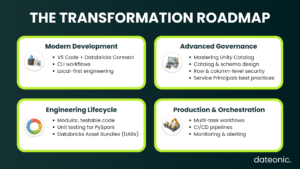
The Syllabus: From Spark Developer to Platform Engineer
Our Corporate Databricks Training is not a generic „Intro to Python” course. It is a rigorous, architectural deep dive designed for teams that need to scale.
- Module 1: The Modern Environment
- Setting up VS Code with Databricks Connect.
- CLI configuration and local development workflows.
- Module 2: Advanced Governance
- Migrating to Unity Catalog.
- Designing catalogs, schemas, and volume access.
- Security best practices (Service Principals vs. Users).
- Module 3: The Engineering Lifecycle
- Writing modular, testable code (no more spaghetti notebooks).
- Unit testing for PySpark.
- Configuring Databricks Asset Bundles (DABs).
- Module 4: Production & Orchestration
- Building multi-task workflows.
- Implementing CI/CD pipelines for automated deployment.
- Monitoring and alerting.
Stop Using 10% of What You Pay For
The gap between a „working script” and a „production platform” is massive. Most companies fail to cross it because they lack the specific, architectural knowledge required to harness the full power of Databricks.
You cannot hire your way out of this problem – the talent pool is too shallow. You must build the capability in-house.
Don’t let your investment sit idle.
Ready to professionalize your Data Platform? Let’s discuss a custom training roadmap for your team.