
All three architectures—data warehouses, data lakes, and data lakehouses—have a role to play in modern enterprise data strategy. But which one aligns best with your business goals, technical capabilities, and AI ambitions?
In this article, I unpack the core differences between these architectures, explore their strengths and limitations, and walk you through real-world use cases to help you choose the right foundation for scalable, future-ready data infrastructure.
What Is a Data Warehouse
A centralized repository optimized for structured, processed data, designed for business intelligence (BI) and reporting.
Key Features:
- Stores curated, schema-on-write data (e.g., SQL tables).
- High-performance querying with tools like Snowflake or Redshift.
- Strong governance and ACID compliance for reliable analytics.
Limitations:
- Struggles with unstructured or semi-structured data (e.g., IoT, logs).
- Expensive for large-scale raw data storage or AI workloads.
- Limited flexibility for machine learning or real-time processing.
What Is a Data Lake
A scalable storage system for raw, unstructured, semi-structured, or structured data, ideal for big data and AI.
Key Features:
- Schema-on-read flexibility, supporting diverse formats (e.g., JSON, Parquet).
- Cost-effective for massive datasets using cloud storage like AWS S3 or Azure Data Lake.
- Supports advanced analytics, machine learning, and data exploration.
Limitations:
- Lacks built-in ACID compliance and transactional integrity, which can lead to issues with data reliability and consistency.
- Governance is often minimal or externally managed, increasing the risk of a “data swamp.”
- Slower for traditional BI due to unoptimized querying and limited indexing.
What Is a Data Lakehouse
A hybrid architecture combining data warehouse and data lake strengths, unifying structured and unstructured data for BI and AI.
Key Features:
- Built on open formats like Delta Lake, with Databricks as a leading platform, lakehouses support full ACID transactions for reliable data operations.
- Supports schema-on-read and schema-on-write for flexibility and performance.
- Enables real-time analytics, machine learning, and BI in one platform.
- Centralized governance via tools like Unity Catalog.
Limitations:
- Emerging technology, requiring expertise for implementation.
- Higher initial setup complexity compared to traditional warehouses.
Key Differences
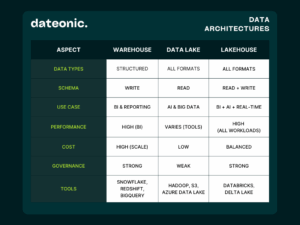
Below, we’ve visualized the core distinctions in governance, performance, cost, and use cases to help you compare architectures quickly:
When to Choose Each
Understanding use cases helps align data architectures with business needs. Below are scenarios where each approach excels.
Data Warehouse
- Financial Reporting: Ideal for scenarios requiring consistent, structured data—such as regulatory compliance or financial audits.
- Retail Dashboards: Suitable for delivering daily operational insights through predefined metrics and high-performance SQL queries.
- Best for: Traditional business intelligence with structured data and predictable, repeatable workloads.
Data Lake
- IoT Analytics: Effective for storing and processing high-volume, time-series data from sensors and devices.
- Customer 360: Useful for unifying diverse data sources—like call logs, social media, and CRM systems—for machine learning and customer segmentation.
- Best for: Large-scale data ingestion, exploration, and AI training on unstructured or semi-structured data.
Data Lakehouse
- Healthcare AI: Enables real-time analytics by merging structured clinical data with unstructured sources like imaging or notes for diagnostic models, similar to how Databricks transforms healthcare data.
- E-commerce Personalization: Supports both inventory management (BI) and recommendation engines (AI) from a single platform using unified data governance.
- Best for: Organizations needing real-time insights across structured and unstructured data, with support for both BI and AI workflows.
| Business Priority | Best Fit Architecture | Why It Fits |
|---|---|---|
| Regulatory Compliance & Reporting | Data Warehouse | Strong governance, reliable SQL analytics. |
| Real-Time Decision Making | Data Lakehouse | Low-latency queries for structured + unstructured data. |
| Cost-Effective Big Data Storage | Data Lake | Cheap storage for massive raw datasets (e.g., logs, IoT). |
| Rapid AI/ML Experimentation | Data Lakehouse | Supports ML workflows, notebooks, model versioning. |
| Departmental BI (e.g., Marketing) | Data Warehouse | Easy BI tool integration, fast dashboard queries. |
| Unified Customer View (360º) | Data Lakehouse | Blends CRM, clickstream, and more for unified insights. |
| High-Volume Ingestion (e.g., IoT) | Data Lake | Scalable, schema-flexible for diverse real-time data. |
Build the Right Data Architecture
Selecting the right architecture requires aligning technology with business goals—and Dateonic is here to guide you through every step.
Our process begins with a strategy workshop to assess your data, AI, and analytics needs, followed by a proof of concept using Databricks to evaluate warehouse, lake, or lakehouse setups. We then implement the chosen solution with automated workflows and pipelines, and establish governance through tools like Medallion Architecture for data quality management.
Whether you’re exploring your options or ready to build, Dateonic’s Databricks expertise ensures your data strategy is future-proof. Contact us to get started.