
AI transformation is accelerating—and two enterprise giants just joined forces.
With Palantir’s operational intelligence and Databricks’ unified lakehouse platform, organizations can now deploy secure, scalable AI across their entire data estate.
In this article, I explore the real-world impact of the partnership—and how it’s reshaping enterprise data strategy.
Why This Partnership Matters
The strategic alliance between Databricks and Palantir addresses one of the most pressing challenges facing enterprises today: operationalizing AI at scale while maintaining robust governance and security.
This partnership combines Databricks’ industry-leading lakehouse architecture with Palantir Foundry’s operational AI capabilities, creating an end-to-end solution that eliminates the traditional silos between data storage, processing, and deployment.
For enterprise CTOs, this means the ability to move from isolated AI experiments to organization-wide AI transformation with unprecedented speed and confidence. The integrated platform enables teams to maintain a single source of truth while deploying AI models that can directly impact operational workflows.
Key Benefits
1. Unified Data Governance
The partnership brings together Databricks’ Unity Catalog with Palantir’s governance framework, allowing organizations to implement consistent security policies across their entire data estate. This unified approach ensures compliance with industry regulations while simplifying access management.
2. Accelerated AI Development Cycles
By connecting Palantir Foundry’s operational workflows directly to Databricks’ lakehouse architecture, organizations can dramatically reduce the time from model development to production deployment. Data scientists can develop models in Databricks while business users can leverage these models through Palantir’s intuitive interfaces without complex hand-offs.
3. Scalable Enterprise AI
The combined platform scales effortlessly from departmental use cases to enterprise-wide applications. This allows organizations to start with targeted AI initiatives that deliver quick wins before expanding to more ambitious transformation projects.
4. Bi-directional Data Flow
The integration enables seamless data movement between systems, ensuring that operational insights from Palantir can inform data science work in Databricks, while models developed in Databricks can be rapidly operationalized through Palantir Foundry.
| Challenge | Databricks + Palantir Solution | Business Impact |
|---|---|---|
| Fragmented Data (Silos) | Unified lakehouse, workflows | Real-time, unified insights |
| Slow AI Deployment | Direct model-to-ops integration | Faster AI project value |
| Compliance Complexity | Unified governance | Lower risk, easier audits |
| Limited AI Reach | Scales AI across teams | Enterprise-wide transformation |
| Disconnected Data Pipelines | Bi-directional data sharing | Smoother, cheaper workflows |
Real-World Applications
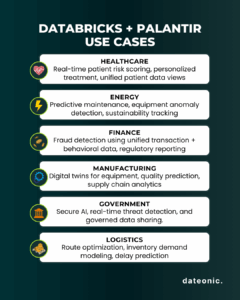
The Databricks-Palantir partnership is poised to transform industries by combining robust data analytics with operational AI. Early adopters, including bp, the Department of Defense, Department of Treasury, and Department of Health and Human Services, are leveraging this integration to drive digital transformation.
Below are examples of how the partnership can deliver value across sectors:
- Energy: bp is using the Databricks-Palantir solution to enhance its digital transformation efforts, integrating Databricks’ AI capabilities with Palantir’s operational workflows to maximize data value and accelerate AI adoption, as highlighted by Emeka Emembolu, EVP Technology at bp.
- Manufacturing: A manufacturer could use Databricks to develop predictive maintenance models and Palantir to embed these insights into real-time workflows, potentially reducing downtime and optimizing equipment performance.
- Financial Services: A financial institution might combine Databricks’ transaction data analysis with Palantir’s real-time operational insights to strengthen fraud detection, improving accuracy and reducing operational costs.
- Healthcare: A healthcare provider could leverage Databricks to analyze patient data and build risk models, with Palantir enabling care teams to act on these insights within existing workflows, potentially enhancing patient outcomes and care coordination.
How to Succeed with the Databricks–Palantir Stack
While the partnership offers tremendous potential, successful implementation requires careful planning:
- Data Strategy Alignment: Organizations should evaluate their existing data architecture and identify how the Databricks-Palantir integration fits into their overall data management strategy.
- Skills Development: Teams will need to develop expertise across both platforms. Consider investing in training programs that bridge the gap between data engineering, data science, and operational workflows.
- Use Case Prioritization: Start with high-value use cases that can demonstrate quick wins before expanding to more complex applications.
- Security Configuration: Properly configure the security settings across both platforms to ensure consistent data protection and access controls.
Getting Started
For organizations looking to leverage the Databricks-Palantir partnership, we recommend starting with a thorough assessment of your current data architecture and AI maturity.
Identify specific use cases where the combined solution could deliver immediate value, and develop a phased implementation approach that aligns with your overall digital transformation strategy.
Curious how to make Databricks and Palantir work for your team?
Our specialists have already delivered results across logistics, finance, and healthcare.
Book a strategy session—let’s build your AI advantage.