
Software engineering solved deployment automation over a decade ago. Yet, step inside the operations center of many modern data teams, and you will still find highly paid data engineers hand-rolling release scripts.
Your engineers are likely spending more time untangling Git branches, wrestling with environment configurations, and debugging custom deployment workflows than actually building scalable data pipelines.
The introduction of Databricks Asset Bundles (DABs) finally brings true Infrastructure as Code (IaC) to the Databricks ecosystem, but adopting them requires a fundamental shift in how your team thinks about CI/CD.
How Most Data Teams Sabotage Their Own Deployments
A pervasive architectural flaw in the enterprise landscape is treating Databricks simply as a managed, basic Spark cluster. By ignoring the platform’s native workflow orchestration and deployment mechanisms, organizations leave massive operational efficiencies on the table.
Instead of a unified release process, teams often rely on a fragile, duct-taped mix of REST API calls, legacy Databricks CLI commands, and overly complex custom Terraform modules just to promote a single notebook from Development to Production. This approach creates bottlenecks and severely limits the scalability of the data platform.
Environment Drift & The Governance Nightmare
When deployments are manual or semi-automated, environment drift is inevitable. Development, Staging, and Production environments quickly fall out of sync.
This isn’t just an operational headache; it is a profound security risk. When service principals, compute configurations, and workspace permissions aren’t strictly codified alongside the pipeline logic, data governance becomes an afterthought rather than a structural guarantee.
The Dateonic Architecture: CI/CD Done Right
Databricks Asset Bundles represent the definitive architectural standard for packaging code, settings, and infrastructure. DABs enforce a templated, version-controlled approach to CI/CD that completely eliminates the „it works on my machine” anti-pattern.
Everything from job definitions and pipeline schedules to cluster policies is defined in YAML and deployed deterministically.
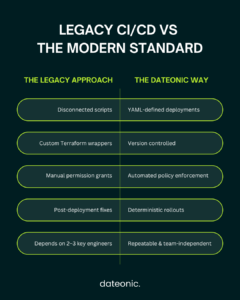
Baking Unity Catalog into Your Release Cycle
Proper architecture demands that data governance is treated as a first-class citizen. At Dateonic, we architect deployments so that DABs interact seamlessly with Unity Catalog.
This ensures that row-level and table-level privileges, along with strict team isolations, are automatically enforced during every automated rollout.
| The Legacy Approach | The Dateonic Way (DABs + Unity Catalog) |
|---|---|
| Infrastructure | Disconnected scripts, custom Terraform wrappers |
| Governance | Manual permission grants post-deployment |
| Environments | High risk of drift between Dev, Staging, Prod |
| Scalability | Relies on tribal knowledge of a few engineers |
See Databricks Asset Bundles in Action
Transitioning from legacy jobs to streamlined Asset Bundles requires practical, hands-on understanding. We believe in showing, not just telling. Check out our public GitHub repository (Dateonic/Databricks-Asset-Bundles-tutorial) for production-grade examples of what we teach.
https://www.youtube.com/@dateonic/videos
Caption: Watch our architects walk through a real-world scenario of migrating a legacy data pipeline into a fully automated Asset Bundle.
Stop Hunting for Unicorns. Build Them.
Let’s address a harsh reality for CTOs and Data Platform Leads: finding external DataOps engineers who possess deep, concurrent expertise in Databricks internals, advanced CI/CD paradigms, and Unity Catalog governance is nearly impossible.
Searching for these „unicorns” drains budgets and stalls critical projects. The most strategic, cost-effective move is to invest in specialized Databricks Asset Bundles Training to upskill your existing, domain-expert internal team.
What Our DABs Training Workshop Delivers
Our training bypasses the basic documentation and focuses on enterprise-grade architectural patterns. We transform your team by delivering:
- Seamless Migrations: Strategies for transitioning legacy jobs, Delta Live Tables (DLT), and MLOps pipelines into unified Asset Bundles.
- Foolproof CI/CD: Hands-on setup of automated pipelines using GitHub Actions, Azure DevOps, or GitLab.
- Environment Management: Mastering variable substitution and environment isolation across Dev, Staging, and Prod.
- Automated Governance: Enforcing security and Unity Catalog policies automatically via deployment code.
Ready to Automate Your Databricks Deployments?
Stop allowing deployment bottlenecks and governance blindspots to slow down your data initiatives. Bring Dateonic in to standardize your architecture and turn your internal engineers into true platform experts.
Would you like to explore how this fits your specific environment? Book a Discovery Call with our Lead Architects to discuss a custom team training program, or download our free Dateonic CI/CD Architecture Checklist to audit your current setup.