
Data silos, inconsistent security rules, and no clear data lineage, these are common pains as data platforms scale. They are also the core problems Databricks Unity Catalog was built to solve, offering a centralized governance model that directly challenges the traditional, per-workspace approach of the Hive Metastore.
In this article, I move beyond a simple feature list to provide a deep, technical comparison of unity catalog vs hive metastore. We’ll explore the architectural differences, practical trade-offs, and strategic impact of choosing one over the other, helping you navigate this critical technical decision.
Understanding Databricks Unity Catalog
Databricks Unity Catalog (UC) is a comprehensive, centralized governance solution for all data and AI assets within the Databricks Lakehouse Platform. Its purpose is to provide a single, unified system for managing access controls, auditing data, and discovering assets, regardless of which workspace they are in.
Key features of Unity Catalog are built to address modern data governance challenges:
- Centralized Access Control: UC provides a „define-once, secure-everywhere” security model. Permissions are set at the account level and enforced across all workspaces, simplifying management.
- Fine-Grained Permissions: It uses a standards-compliant ANSI SQL model to grant permissions at the row, column, table, schema, and catalog level.
- Built-in Auditing and Lineage: Unity Catalog automatically captures detailed audit logs of all actions performed against data. It also provides end-to-end data lineage, tracking how data flows from source to dashboard, which is critical for compliance and impact analysis.
- Unified Data Discovery: It serves as a central catalog for all data assets, including tables, files, and even AI models, making them easily searchable and discoverable.
- Manages All Assets: UC can govern both managed and external tables, giving teams flexibility in how they manage their data storage.
Unity Catalog is deeply integrated into the Databricks ecosystem. It introduces a multi-tenant metastore that is shared per region, a significant shift from the per-workspace model of its predecessor.
It also establishes a clear, three-level namespace (catalog.schema.table) for organizing data, which allows for better data isolation and organization than the traditional two-level system.
Understanding Hive Metastore
The Hive Metastore has long been the standard metadata repository for environments built on Apache Hive. Its primary purpose is to store the metadata – such as table schemas, data types, and partition information, for data stored in Hadoop-based systems like HDFS.
Originating from the Hadoop ecosystem, the Hive Metastore was designed to bring SQL-like querying and structure to massive, unstructured datasets.
- Core Functionality: It allows query engines like Spark or Tez to understand the structure of data in various formats, such as Parquet, ORC, and CSV.
- SQL Interface: It provides the schema-on-read capability that enables users to run SQL queries against files stored in a data lake.
- Historical Context: It was a reliable and essential component for enabling data warehousing tasks in traditional big data stacks.
However, in modern, cloud-native contexts, its limitations become apparent. The Hive Metastore was not designed for the complex governance needs of today. It generally lacks built-in features for fine-grained access control, automated data lineage, and comprehensive auditing.
Security policies are often managed at the workspace or cluster level, creating data silos and a significant management burden.
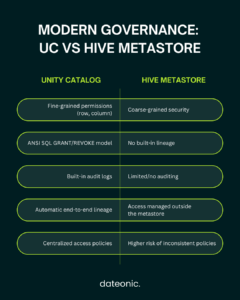
Key Differences Between Unity Catalog and Hive Metastore
The most significant differences between the two systems lie in their architecture, governance capabilities, and scope.
- Architecture:
- Unity Catalog: Features a centralized, multi-tenant metastore at the account/region level. A single UC metastore can be attached to and govern multiple Databricks workspaces.
- Hive Metastore: Traditionally deployed as a per-workspace service. Each workspace has its own metastore, making it difficult to share data or enforce consistent policies across workspaces.
- Governance and Security:
- Unity Catalog: Provides fine-grained, centralized governance using ANSI SQL (e.g., GRANT SELECT ON table). It includes built-in, automated auditing and lineage tracking for all assets.
- Hive Metastore: Offers simpler metadata management. Access control is typically managed outside the metastore (e.g., at the cloud storage level or via cluster configurations) and lacks the granularity and central control of UC.
- Object Management:
- Unity Catalog: Uses a three-level namespace (catalog.schema.table). This extra layer (catalog) allows for much cleaner data organization and isolation, often used to separate environments (dev, prod) or business units.
- Hive Metastore: Uses a traditional two-level namespace (schema.table, where schema is often called 'database’).
- Scope and Interoperability:
- Unity Catalog: Designed to be the governance layer for all data and AI assets, including tables, files, and ML models. It is built on open-source principles to work with various data formats.
- Hive Metastore: Primarily focused on managing tabular data schemas within the Hadoop and Spark ecosystem.
Comparison Summary
| Feature | Databricks Unity Catalog | Hive Metastore |
|---|---|---|
| Architecture | Centralized, account-level metastore | Per-workspace service |
| Namespace | Three-level (catalog.schema.table) | Two-level (schema.table) |
| Access Control | Fine-grained (row, column) ANSI SQL | Coarse-grained, often external |
| Auditing | Built-in, comprehensive audit logs | Limited to non-existent |
| Data Lineage | Automated, end-to-end (column-level) | Not a built-in feature |
| Data Sharing | Native, secure sharing (Delta Sharing) | Manual and complex |
| Asset Scope | Tables, Files, AI Models, Volumes | Primarily tables |
Pros and Cons of Databricks Unity Catalog
Pros
- Enhanced, Centralized Security: A „define-once, secure-everywhere” model with fine-grained permissions and a principle of least-privilege access.
- Comprehensive Governance: Automated auditing and data lineage provide full visibility for compliance (like GDPR or HIPAA) and impact analysis.
- Improved Data Discovery: A unified catalog for all assets, enhanced with tagging and search, breaks down data silos.
- Modern Data Sharing: Natively integrates with Delta Sharing, an open-source protocol for secure data sharing with other organizations.
- Governs All Assets: Provides a single control plane for all data and AI assets, not just tables.
Cons
- Migration Effort: Moving from a legacy Hive Metastore to Unity Catalog requires a planned migration, though Databricks provides tools to assist.
- Platform-Specific: It is a core component of the Databricks platform. While it’s built on open principles, its primary value is realized within the Databricks ecosystem.
Pros and Cons of Hive Metastore
Pros
- Simplicity: For basic metadata management in a single, non-governed environment, it is simple and well-understood.
- Proven and Mature: It is a battle-tested technology that has been reliable in traditional Hadoop environments for many years.
- Open-Source: As a core Apache Hive component, it is open-source and has broad community support in the Hadoop world.
Cons
- Limited Governance: Lacks the fine-grained security, auditing, and lineage required for modern data governance and compliance.
- Creates Silos: The per-workspace model makes it extremely difficult to share data or enforce consistent policies across teams.
- Not Optimized for AI: It is not designed to govern AI and ML assets, a critical part of the modern data lakehouse.
- Scalability and Management Overhead: Managing multiple metastores and their disparate security rules becomes a significant operational bottleneck.
When to Choose Unity Catalog vs Hive Metastore
The choice between Unity Catalog vs Hive Metastore is a strategic one that depends on your organization’s maturity and goals.
Scenarios for Databricks Unity Catalog:
You should choose Unity Catalog if your organization:
- Uses multiple Databricks workspaces and needs to share data securely between them.
- Requires a modern data governance solution with fine-grained access controls, auditing, and lineage for compliance.
- Is building a Lakehouse Architecture and needs to govern data and AI assets together.
- Is scaling its data operations and wants to reduce the complexity of managing disparate security policies.
Scenarios for Hive Metastore:
You might remain on the Hive Metastore if you:
- Are running a single, legacy Hadoop or Spark environment with no plans to migrate.
- Have very simple data needs with no requirements for advanced security, sharing, or governance.
- Are in the very early stages of a migration to Databricks and are using the built-in Hive Metastore as a temporary step before upgrading to UC.
For nearly all modern use cases on Databricks, the question is not if but when to adopt Unity Catalog.
Conclusion
The unity catalog vs hive metastore comparison highlights a clear evolution in data management. While the Hive Metastore was a foundational tool for the big data era, its limitations in governance, security, and scalability are significant in the modern, multi-cloud world.
Databricks Unity Catalog directly addresses these shortcomings. It provides the centralized, fine-grained, and unified governance layer that organizations need to securely and effectively scale their data and AI initiatives.
For any organization serious about building a secure, compliant, and discoverable data platform on Databricks, adopting Unity Catalog is a critical and strategic step forward.
Navigating the technical decisions and migration from a legacy metastore can be complex. If your organization is looking to implement Databricks and leverage the full power of Unity Catalog, partner with experts who have deep platform knowledge.
Contact Dateonic to learn how our tailored Databricks solutions can help you build a robust and modern data governance strategy.