
Alteryx provides a no-code interface that works with Databricks’ data processing engine, allowing business users to analyze data without writing code.
This article explains how this technical partnership simplifies AI-driven insights, enhances governance, and enables organizations to utilize Databricks’ capabilities more effectively.
Bridging the Technical Divide
Databricks provides data processing capabilities that data scientists and engineers utilize effectively. However, business teams often lack the coding skills needed to use the platform directly. This creates a bottleneck where business users must wait for technical support to access data insights.
Alteryx addresses this challenge through its visual, drag-and-drop interface. The integration allows business analysts, marketers, finance professionals, and operations teams to directly access Databricks data without writing code. Tasks that previously required technical intermediaries can now be completed independently by the people closest to business decisions.
Simplifying Data Analytics
The integration enables business users to:
- Access and query Databricks tables through visual interfaces
- Blend Databricks data with information from other systems
- Create repeatable workflows for routine analysis
- Generate visualizations and reports without coding
- Apply AI insights to business decisions
This accessibility changes how organizations use their lakehouse architecture, extending the value of Databricks beyond technical teams to departments that rely on data for decision-making.
Here’s a comparison of what each platform contributes:
| Capability | Alteryx | Databricks |
|---|---|---|
| User Interface | Drag-and-drop, low-code | Notebook + Spark code |
| Data Integration | Connectors to DB tables & BI tools | Data ingestion, Delta Lake |
| Workflow Automation | Repeatable workflows with scheduling | Job clusters, Delta Live Tables |
| Governance & Lineage | Usage visibility, audit trails | Unity Catalog, access controls |
| AI/ML Accessibility | Point-click model application | MLflow model training & deployment |
Maintaining Security While Expanding Access
When increasing access to enterprise data, governance remains necessary. The Alteryx-Databricks integration addresses this through:
- Visibility into who accesses data through Alteryx
- Integration with Unity Catalog for consistent security policies
- Tracking of how Databricks data is used across teams
- Ability to establish standardized data handling practices
This visibility allows organizations to expand access while maintaining appropriate protections for sensitive information and ensuring secure data management.
Operationalizing AI for Business Users
The integration extends beyond basic data access to make AI capabilities accessible to business users. While Databricks provides machine learning functionality, Alteryx makes these capabilities available through simplified interfaces.
Business analysts can incorporate AI models into their workflows without understanding the underlying code. Marketing teams can apply customer propensity models to campaigns. Operations teams can use anomaly detection to identify potential equipment failures.
This wider distribution of AI aligns with the trend toward enterprise AI platforms that serve diverse user needs across organizations.
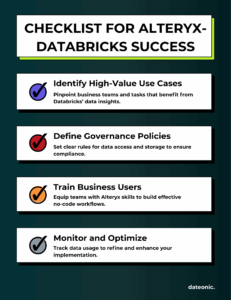
Checklist for Alteryx-Databricks Success
To implement an Alteryx-Databricks integration effectively, consider these steps. Each stage helps ensure adoption, governance, and business impact:
Unlocking Value
For organizations that have invested in data management systems but struggle to extract full value, this integration offers a solution. By connecting Databricks’ processing capabilities with Alteryx’s no-code interface, businesses can utilize their data investments more effectively.
Business teams gain independence and faster insights. Technical teams can focus on complex work instead of routine data requests. The organization can make more data-informed decisions across departments.
Contact us to discuss implementation options suited to your organization’s needs.