
Meta Llama 3, released on April 18, 2024, by Meta AI, has rapidly become a dominant force in the open-source AI community.
In this article, I explore how Llama 3 achieved such widespread adoption in just four weeks, setting a new standard for open-source large language models (LLMs).
The Rise of Open-Source AI
Open-source AI models are crucial for democratizing access to advanced technology, fostering a global environment of innovation and collaboration.
They allow developers and researchers to freely use, modify, and distribute powerful tools, which accelerates progress in the field. The Llama series from Meta has been a significant contributor to this movement.
The journey began with Llama 1 in 2023, which was available to researchers, and continued with Llama 2, which offered commercial use licenses, expanding its reach. Llama 3 builds upon this legacy with enhanced performance and even broader accessibility.
| Model | Release Year | License Type | Key Highlights |
|---|---|---|---|
| Llama 1 | 2023 | Research only | Limited access, academic use |
| Llama 2 | 2023 | Commercial use OK | Widely adopted, major upgrade |
| Llama 3 | 2024 | Open with AUP | 15T tokens, top-tier benchmarks |
| Llama 3.1+ | 2024–2025 | Ongoing updates | Continued performance improvements |
The Launch and Features of Llama 3
Llama 3 was launched with 8B and 70B parameter models, with a 400B parameter model released later. It was made immediately available on major cloud platforms like AWS, Google Cloud, and Microsoft Azure, as well as on Hugging Face. This wide distribution was a key factor in its rapid adoption.
Key improvements in Llama 3 include:
- A more efficient tokenizer and a grouped query attention (GQA) mechanism.
- Training on 15 trillion tokens of data, a sevenfold increase compared to Llama 2, which significantly boosted its performance.
- Superior performance on various benchmarks in April 2024, outperforming models like Gemini Pro 1.5 and Claude 3 Sonnet.
Meta also integrated Llama 3 into its own products, introducing virtual assistant features to Facebook and WhatsApp in some regions and launching a dedicated website.
Unprecedented Adoption
The response from the AI community was immediate and overwhelmingly positive.
- In its first week, Llama 3 was downloaded over 1.2 million times, as reported by Meta AI.
- Over 600 derivative models were created on Hugging Face, showcasing the vibrant engagement of developers.
- In the Chatbot Arena, a crowdsourced platform for LLM evaluation, Llama 3 engaged in 12,719 battles with 7,591 unique judges between April 24 and May 1, 2024, highlighting its popularity and the community’s interest.
What Drove the Rapid Adoption?
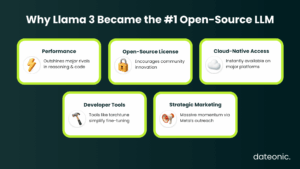
Several factors contributed to Llama 3’s quick success:
- State-of-the-Art Performance: Llama 3’s impressive performance, particularly in reasoning and coding tasks, made it a top choice for developers. For those looking to get the most out of their AI models, understanding performance techniques is crucial.
- Open-Source Nature: The model’s open-source license encouraged a collaborative ecosystem. Tools like torchtune from PyTorch simplified the process of fine-tuning the model for specific needs.
- Support from Tech Giants: Partnerships with major cloud providers ensured that Llama 3 was easily accessible and scalable. This integration into top enterprise AI platforms was a significant advantage.
- Strategic Marketing: Meta’s promotional efforts, including press releases and blog posts, generated considerable excitement and awareness.
Impact on the AI Community
Llama 3’s success has had a profound impact on the open-source AI landscape. It has spurred greater interest in open-source projects and set a new benchmark for performance, rivaling even proprietary models like GPT-4 and Claude 3.
The explosion of derivative models on Hugging Face is a testament to its role as a catalyst for innovation. For enterprises, managing the data for these powerful models is a key consideration, and there are now specialized platforms for managing important company data.
Challenges and Criticisms
Despite its success, Llama 3 has faced some criticism. Researchers from Radboud University and a November 2024 article in Nature have argued that the model’s licensing terms are not fully open-source, a practice they term „openwashing.” They point to restrictions in the acceptable use policy as a key concern.
In response, Meta has emphasized its commitment to open innovation through initiatives like the AI Alliance and the Llama Impact Grants, which support the development of AI for social good.
The Future of Llama and How to Get Involved
Llama 3’s rapid rise to prominence in the open-source AI world was the result of its powerful performance, widespread accessibility, and Meta’s strategic initiatives. With the release of Llama 3.1 and 3.2, Meta continues to push the boundaries of open-source AI.
- Explore Llama 3: Developers and AI enthusiasts are encouraged to explore Llama 3 and its capabilities for innovative applications.
- Stay Up-to-Date: Stay informed about the latest advancements in open-source AI by visiting Meta’s Llama website or following industry updates on platforms like Hugging Face.
- Official Resources: You can find technical documentation and tools on the Llama 3 GitHub repository and the official Meta AI blog.
Further Insights from Dateonic
For deeper dives into enterprise AI platforms, performance optimization, and how to manage crucial company data in the age of LLMs, explore the resources and articles available at Dateonic.