
Enterprise AI projects rarely fail because of the algorithms. They fail because of fragile, undocumented, and poorly governed data pipelines. Raw data is a liability; it is noisy, inconsistent, and unstructured. To build reliable machine learning models and accurate business intelligence, data must be rigorously engineered.
For teams learning how to clean and transform data in Databricks, the platform provides a unified Lakehouse environment that scales massive workloads while enforcing strict enterprise governance. This guide breaks down the architectural patterns, core tools, and best practices required to build production-grade data pipelines.
The Crucial Role of Data Transformation in the Lakehouse
Moving machine learning projects from the discovery phase to production requires consistent data quality. Legacy ETL tools and fragmented data warehouses often create bottlenecks, struggling to process large volumes of streaming and batch data simultaneously.
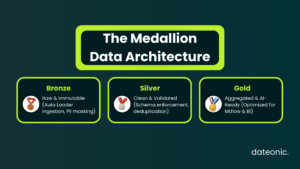
To solve this, modern Lakehouse architectures rely on the Medallion architecture. This framework logically organizes data into three distinct layers, progressively improving structure and quality:
- Bronze: Raw, untransformed data ingested directly from source systems.
- Silver: Cleaned, filtered, and augmented data, representing an enterprise-wide “single source of truth.”
- Gold: Highly refined, aggregated data optimized for specific machine learning features or business intelligence reporting.
Core Databricks Tools for Data Engineering
Before writing transformation logic, you must choose the right execution engine. Databricks offers several native tools to handle data processing, depending on your workload:
- Apache Spark (PySpark/Scala): The standard for programmatic data manipulation. PySpark is ideal for complex, custom transformations and migrating legacy Hadoop workloads. It seamlessly handles both batch processing and structured streaming.
- Databricks SQL: Designed for analysts and engineers who prefer writing declarative SQL. It leverages robust compute clusters optimized for fast query execution on data lake storage.
- Delta Live Tables (DLT) & LakeFlow: A declarative framework for building reliable data pipelines, currently evolving into the broader Databricks LakeFlow ecosystem. Instead of manually orchestrating task dependencies, engineers define the target state of the data, and DLT automatically manages infrastructure, dependencies, and quality checks.
| Tool | Best For | Key Advantage |
|---|---|---|
| Apache Spark (PySpark/Scala) | Complex transformations | Handles batch and streaming workloads |
| Databricks SQL | SQL-based analytics | Fast query performance on lake storage |
| Delta Live Tables (DLT) | Automated pipelines | Built-in orchestration and quality checks |
| LakeFlow | Modern pipeline management | Simplifies end-to-end data workflows |
Step 1: Ingesting Raw Data (Bronze Layer)
The primary goal of the Bronze layer is to capture a historical, immutable record of incoming data. Transformations here should be minimal.
Whether you are using Databricks Auto Loader for streaming ingestion or batch loading files from cloud storage, the data should be appended as-is. However, there is one critical exception: Personally Identifiable Information (PII).
To maintain strict security and compliance, highly sensitive PII should be isolated, masked, or tokenized. It is important to note that this masking is applied via transformation logic immediately after the raw data is ingested by Auto Loader, ensuring sensitive data is secured before it propagates downstream to the Silver layer.
Step 2: Cleaning and Validating Data (Silver Layer)
The Silver layer is where core data transformations and data quality enforcement occur. Because Databricks uses Delta Lake as its default storage format (since Databricks Runtime 8.0), all operations benefit from ACID transactions, ensuring that data is never left in a corrupted state during complex transformations.
Core operations at this stage include:
- Schema Enforcement and Evolution: Delta Lake automatically prevents bad data from corrupting your tables by strictly enforcing schema. If upstream data changes intentionally, you can use mergeSchema to safely evolve the table.
- Handling NULLs and Duplicates: Standardize missing values and drop duplicates to ensure model accuracy. In PySpark, engineers typically execute this using native dataframe methods like df.dropna(), df.fillna(), and df.dropDuplicates().
- Data Quality Constraints: Databricks allows you to enforce table constraints directly using SQL (e.g., ALTER TABLE table_name ADD CONSTRAINT valid_age CHECK (age > 0)).
For automated pipelines, Delta Live Tables simplifies this by using “Expectations.” You can explicitly define how the pipeline should handle invalid data:
import dlt
from pyspark.sql.functions import expr
@dlt.table
@dlt.expect_or_drop(“valid_id”, “id IS NOT NULL”)
def silver_users():
return dlt.read_stream(“bronze_users”).dropDuplicates([“id”])
Step 3: Aggregating and Enriching for AI & BI (Gold Layer)
In the Gold layer, data is joined, aggregated, and formatted for its final use case. This layer must deliver high performance for downstream MLflow model training and BI dashboarding.
Storage and compute optimization is critical here. To ensure fast querying, implement partitioning on columns frequently used in WHERE clauses (like date or region). For deeper optimization, use the OPTIMIZE command alongside ZORDER to co-locate related information in the same data files, drastically reducing the amount of data Spark needs to scan.
OPTIMIZE gold_sales_data
ZORDER BY (customer_id, product_category);
Enforcing Data Quality and Governance
Even perfectly transformed data is useless if it is not secure. A production-ready Lakehouse requires centralized governance.
Databricks Unity Catalog provides a unified governance solution across all workspaces. It allows enterprise organizations to:
- Implement strict, role-based and view-based access controls.
- Track data lineage from the Bronze layer all the way to deployed machine learning models.
- Audit data access centrally to ensure compliance.
Scale Your Databricks Pipelines with Dateonic
Building a theoretical data pipeline is one thing; deploying a secure, cost-optimized, and resilient architecture at an enterprise scale is another.
As an Official Databricks Consulting Partner, Dateonic specializes in modernizing legacy systems and building the robust data foundations required for reliable AI. We do not deal in AI hype. We focus on rigorous data engineering, Unity Catalog governance, and strict MLOps standards.
Whether you need to untangle fragmented pipelines or optimize your cluster compute costs, our engineers build the reliable pathways from raw data to actionable intelligence. Read our technical blog for deep dives into Delta Lake implementations, or reach out to our team directly.
Talk to a Databricks expert today to assess and optimize your enterprise data architecture.
FAQ
What is the Medallion architecture in Databricks?
It is a data design pattern that logically organizes data into Bronze (raw), Silver (cleaned and validated), and Gold (aggregated and business-ready) layers to progressively improve data quality.
Why use Delta Lake for data transformation?
Delta Lake provides ACID transactions, scalable metadata handling, and unifies streaming and batch data processing, ensuring your data pipelines are reliable and do not fail mid-write.
How does Unity Catalog improve data quality?
Unity Catalog centralizes data governance, allowing administrators to manage access permissions, track end-to-end data lineage, and audit usage across the entire Databricks environment.
Conclusion
To build production-ready AI, organizations must treat data transformation as a critical engineering discipline, not an afterthought. By leveraging the Medallion architecture, Delta Live Tables, and Unity Catalog within Databricks, enterprises can create the resilient, governed pipelines necessary to turn raw data into scalable intelligence.