
Migrating to a modern Lakehouse architecture or moving machine learning projects from discovery into production requires more than just provisioning a cloud workspace. Without the right technical foundation, enterprise organizations often face stalled migrations, soaring compute costs, and fragmented data pipelines.
To prevent these bottlenecks, defining the right roles for a Databricks implementation is a critical first step. Relying on generalist IT or software development teams is a common pitfall. A successful deployment requires highly specialized ecosystem expertise across data engineering, MLOps, governance, and infrastructure planning.
In this guide, I break down the multidisciplinary team needed to take a Databricks Lakehouse from a conceptual architecture to a secure, scalable, and production-ready system.
Why Specialized Roles Matter in Databricks Implementations
The shift from legacy systems, such as Hadoop or traditional on-premise data warehouses, to a modern Lakehouse architecture introduces new operational paradigms. Unified Lakehouse architectures offer elastic compute scalability, but without rigorous management, this leads to rapid budget burn.
When enterprises assign general cloud engineers to manage Databricks environments, unoptimized cluster configurations waste compute budgets, data engineers spend weeks untangling permissions, and AI models remain trapped in isolated discovery notebooks. Building a production-grade system requires professionals who understand the nuances of the Databricks ecosystem, ensuring your deployment focuses on robust data governance, strict cost control, and structured machine learning operations (MLOps) right out of the gate.
Core Roles for a Production-Ready Databricks Team
A scalable enterprise deployment requires a balance of platform strategy, pipeline engineering, and strict governance. The table below outlines the core roles and their primary Databricks tooling.
| Role | Primary Responsibility | Key Databricks Tooling |
|---|---|---|
| Platform Architect | Strategy, workspace design, cost control | Workspace policies, Serverless SQL |
| Senior Data Engineer | Medallion architecture, pipeline builds | Apache Spark, Delta Live Tables |
| MLOps Engineer | Operationalizing ML and GenAI models | MLflow, Model Registry |
| SecOps / Governance | Access control, data lineage, compliance | Unity Catalog |
| DevOps / SRE | CI/CD, infrastructure as code, reliability | Terraform, Databricks Asset Bundles |
Databricks Platform Architect / Lead
The Platform Architect designs the overall strategy and structural foundation of the Lakehouse. This role oversees workspace design, network topology, and compute resource allocation.
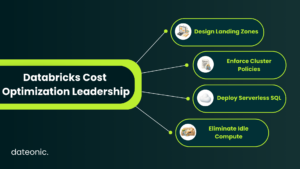
- Core Responsibilities: Designing landing zones, establishing cluster policies to enforce cost optimization, and determining the overall compute strategy.
- Why You Need Them: A primary reason cloud migrations stall is a failure to plan for cost optimization. The Architect leverages tactics like using Serverless SQL warehouses to eliminate idle cluster costs, ensuring hundreds of users can query data simultaneously without budget overruns.
Senior Data Engineer (Spark & Delta Lake)
The Data Engineer physically builds the pipelines that move raw data into actionable intelligence, requiring deep expertise in Apache Spark and Delta Lake capabilities.
- Core Responsibilities: Designing high-throughput, fault-tolerant pipelines. They implement the Medallion architecture (Bronze for raw data, Silver for cleansed data, and Gold for business-level aggregates) using tools like Delta Live Tables.
- Why You Need Them: Generalist software engineers often struggle with distributed data processing. Specialized data engineers ensure complex transformations run efficiently and adhere to strict data quality checks.
Machine Learning Engineer (MLOps)
The Machine Learning Engineer bridges the gap between data science experimentation and reliable production systems, focusing on operationalizing models rather than just building them.
- Core Responsibilities: Managing the entire model lifecycle using MLflow. They build automated MLOps pipelines, track model experiments, and deploy GenAI solutions into secure, scalable endpoints.
- Why You Need Them: A well-structured team is the difference between AI models that stay in the lab and systems that deliver business value. The ML Engineer takes models out of isolated discovery notebooks and ensures they are retrained, versioned, and monitored for drift in production.
SecOps and Data Governance Specialist
Security and governance cannot be an afterthought in Big Data. This specialist untangles fragmented data permissions and enforces enterprise security standards.
- Core Responsibilities: Designing fine-grained access controls (row and column-level security), setting up audit logging, and managing data lineage.
- Why You Need Them: This role relies heavily on Unity Catalog to centralize governance across the entire Lakehouse. They ensure data scientists have necessary access without compromising regulatory compliance or exposing sensitive personally identifiable information (PII).
DevOps / Site Reliability Engineer (SRE)
The DevOps or SRE role ensures that the Databricks infrastructure is reliable, reproducible, and safely deployed across development, staging, and production environments.
- Core Responsibilities: Managing infrastructure via code using Terraform, implementing CI/CD pipelines, and streamlining deployments.
- Why You Need Them: Manual configuration of cloud workspaces leads to configuration drift and security vulnerabilities. By replacing legacy CI/CD scripts with Databricks Asset Bundles (DABs), the SRE standardizes project deployments and maintains platform reliability at scale.
Structuring Your Team for Enterprise Scale
For enterprise scale, these specialized roles cannot operate in silos. A successful Databricks deployment requires a unified operating model.
The Platform Architect sets the boundaries in which the Data Engineers build pipelines. The structured data feeds directly into the feature stores utilized by Machine Learning Engineers. Meanwhile, SecOps ensures that Unity Catalog policies govern the entire lifecycle, from raw ingestion in the Bronze layer to the deployment of a GenAI model.
By leveraging unified Databricks tooling, teams break down traditional barriers between data engineering and data science, ensuring faster deployment cycles and reliable intelligence.
Bridging the Talent Gap: In-House vs. Certified Databricks Partners
Sourcing deeply specialized Databricks talent is difficult. Finding engineers with hands-on experience in Unity Catalog rollouts or MLflow standardization – validated by credentials like the Databricks Certified Data Engineer Professional certification, often delays critical data initiatives by months.
This is where specialized partnerships become invaluable. Generalist IT agencies lack the specific ecosystem expertise required for rigorous cluster optimization and enterprise security.
As an Official Databricks Consulting Partner, Dateonic structures its entire engineering philosophy around the Databricks ecosystem. Whether you require full Data & AI Platform Implementation or highly technical staff augmentation to accelerate your internal roadmap, our teams bring the exact blend of architecture, MLOps, and engineering expertise required for enterprise success.
For deeper technical insights on how our specialists implement Unity Catalog or standardize MLOps pipelines, explore the Dateonic Technical Blog.
FAQ
- What is the most critical role for cost optimization in Databricks? The Databricks Platform Architect is primarily responsible for cost optimization. They enforce strict cluster policies, manage auto-scaling rules, and decide when to utilize serverless compute to prevent budget overruns.
- Why do I need a dedicated MLOps engineer instead of just Data Scientists? Data Scientists excel at algorithm discovery and model training. MLOps Engineers possess the specific software engineering and infrastructure skills needed to take those models out of isolated Databricks notebooks and deploy them into reliable, automated production pipelines using MLflow.
- How does Unity Catalog impact the team structure? Unity Catalog centralizes governance across the entire Lakehouse. This allows the SecOps and Governance Specialist to manage permissions, data lineage, and audit logs from a single interface, significantly reducing the administrative burden on individual Data Engineers.
Conclusion
Successfully implementing a modern Data & AI platform demands a highly technical, multidisciplinary team. By defining specific roles for architecture, pipeline engineering, MLOps, governance, and infrastructure reliability, your enterprise can prevent cloud migrations from stalling and move AI out of the discovery phase.
Ready to scale your analytics with an enterprise-grade Lakehouse architecture? Talk to a Databricks expert at Dateonic today to discuss your Data & AI Platform Implementation or Databricks Consulting & Staff Augmentation needs.