
In a major development for enterprise technology, SAP and Databricks have announced a partnership that unifies enterprise data management and AI capabilities. This collaboration brings together SAP, the world’s leading provider of business software, with Databricks, a premier Data Intelligence Platform, to create the new SAP Business Data Cloud—a solution that promises to transform how organizations leverage their data assets.
In this article, I break down the key components of this partnership, compare it with traditional SAP data integration methods, and explore its potential impact on enterprise AI, data governance, and cross-functional business innovation.
SAP Business Data Cloud
At the core of this partnership is the newly introduced SAP Business Data Cloud, a comprehensive solution that unifies all SAP and third-party data throughout an organization. This platform creates a trusted data foundation that enables more impactful business decisions and fosters reliable AI implementation across enterprise operations.
The solution harmonizes data from mission-critical applications with advanced data engineering and business analytics capabilities. Most importantly, SAP Business Data Cloud natively embeds Databricks technology for data engineering, machine learning, and AI workloads—creating an unprecedented integration of enterprise software and data intelligence.
Bridging Critical Business Data
A key component of this collaboration is SAP Databricks, which will be a native component within the SAP Business Data Cloud. This integration addresses a long-standing challenge for enterprises: combining critical SAP business data with modern data platforms for advanced analytics and AI applications.
SAP Databricks provides customers with artificial intelligence, data warehousing, and data engineering capabilities, all governed by Unity Catalog. This enables organizations to bi-directionally share data between SAP Databricks and their enterprise environment while ensuring SAP data retains all of its valuable business context and semantics.
Traditional Integration vs SAP Databricks
| Aspect | Traditional SAP Data Integration | SAP Databricks Approach |
|---|---|---|
| Data Movement | Complex ETL processes required | Native connectivity with minimal movement |
| Semantic Context | Often lost during extraction | Full preservation of business context |
| Integration Time | Weeks or months to integrate | Days to connect data sources |
| Data Currency | Usually batch-processed with delays | Near real-time data synchronization |
| Governance | Fragmented across systems | Unified through Unity Catalog |
| AI Capabilities | Limited by data silos | Enhanced by connected data landscape |
| Development Experience | Specialized SAP knowledge required | Familiar Databricks environment |
| Deployment Options | Limited flexibility | Available on Azure, AWS, and GCP |
Introducing the Data Product Economy
SAP Business Data Cloud fosters the growth of what SAP calls a „data product economy.” The platform delivers fully-managed SAP data products across all business processes—from finance, spend, and supply chain data in SAP S/4HANA and SAP Ariba, to learning and talent data in SAP SuccessFactors.
These data products maintain their original business context and semantics, providing immediate access to high-quality data without costly extraction processes. For example, when a CFO needs to assess the impact of rising inflation on profitability, SAP Business Data Cloud can integrate real-time external data such as consumer price indices with financial data products like general ledger accounts or cost centers.
Enhancing AI Capabilities
The partnership significantly improves how Joule, SAP’s generative AI copilot, accelerates cross-functional workflows and supports business decision-making with AI agents. Powered by enterprise datasets and the SAP Knowledge Graph solution, Joule agents can deeply understand end-to-end processes and collaborate across functions to solve complex business challenges.
This implementation of enterprise AI platforms offers ready-to-use Joule agents across finance, service, sales, and other business functions. For example:
- Finance agents work together to process claims faster and improve cash flow
- Sales agents accelerate multi-step business processes to resolve disputes
- Service agents streamline customer inquiries for faster resolution
SAP has also announced a new agent builder capability, allowing customers to develop and deploy their own AI agents alongside SAP’s library of ready-to-deploy Joule agents.
Industry Impact
The market response to this partnership has been enthusiastic, with major global enterprises already recognizing its potential:
Bin Mu, Vice President of Enterprise Data & Analytics at Adobe Technology Services, noted that their collaboration with Databricks and SAP will power high-value, AI-driven insights across several business functions, including sales, finance, supply chain, and products.
Jelle van Etten, Global Head of Data Platforms at Heineken, highlighted how the partnership supports their goal of becoming the best-connected brewer for digital-age consumers by developing a central source of truth for all their data.
Markus Hartmann, Corporate Vice President at Henkel, emphasized how SAP Business Data Cloud will help unlock the value of their data and drive innovation by enhancing existing data products and empowering scenario modeling with AI insights.
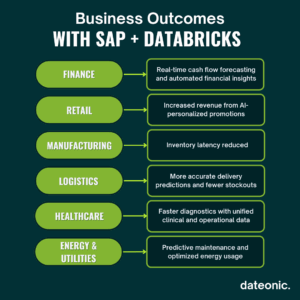
The SAP-Databricks partnership delivers measurable benefits across industries, as shown below. Note that implementation may require data harmonization efforts and varies by organization.
Strategic Investment
Underscoring the significance of this partnership, Databricks has announced it will earmark $250 million to help make customers and SI partners successful with SAP Databricks across deployment, migrations, and unlocking business value from SAP data.
This level of investment highlights how seriously both companies view the potential impact of their collaboration on the data management landscape and enterprise AI implementation.
The Future of Enterprise Data Management
The SAP-Databricks partnership represents a significant evolution in how enterprises can harness their data assets. By combining SAP’s business process expertise with Databricks’ data platform capabilities, organizations can build toward a future of truly integrated, AI-enhanced operations.
This collaboration addresses one of the core challenges in modern data architecture: breaking down silos between business applications and data platforms. The resulting capability—enterprise-wide orchestration of data and AI—promises to transform how businesses operate and make decisions.
For organizations looking to explore how these technologies can transform their data strategy and business operations, connect with data experts at dateonic to learn more about implementation possibilities.