
Databricks consulting proposals often promise the same things: a modern lakehouse, stronger governance and production-ready AI.
To compare companies meaningfully, you need to know who will build the platform, what comparable work they have delivered and how much of the surrounding transformation they can take on.
A defined pipeline migration and a data program spanning multiple countries call for different teams. A manufacturer connecting plant systems needs different evidence from a bank rebuilding access controls and reporting.
This comparison covers five providers: Dateonic, Accenture, Capgemini, Deloitte and Perficient. It brings together public project evidence, documented capabilities and practical questions to help you build a shortlist.
Five Databricks consultancies at a glance
The project fits below are editorial assessments based on the evidence reviewed.
| Company | Project fit to explore | Relevant public evidence | Buyer consideration |
|---|---|---|---|
| Dateonic | Defined platform builds, pipeline migration and engineering-led governance work | Anonymized governance, manufacturing and maritime implementations | Confirm assigned engineers, delivery capacity and support scope |
| Accenture | Enterprise programs combining platform delivery with wider organizational change | Databricks alliance and 2026 Global Partner recognition with Avanade | Establish the contracting team and responsibilities across workstreams |
| Capgemini | International governance migrations and industrial data programs | Databricks 2026 EMEA recognition and industrial partnership material | Verify local delivery and plant-system integration experience |
| Deloitte | Governance-heavy modernization, banking and public-sector initiatives | 2026 sector recognition and a published Nestlé USA implementation | Agree who owns technical controls and acceptance evidence |
| Perficient | Modernization that connects Databricks with enterprise applications and cloud services | Current partner page, specialization announcements and integration case material | Test the relevance of its tooling to your source systems |
How these companies were selected
For this update, we reviewed the five previously featured firms against their current Databricks materials, project descriptions and partner recognition.
Each remains relevant for a different reason: documented platform engineering, enterprise integration, industrial data delivery or governance-led modernization. Together, they offer a useful comparison between focused implementations and broader transformation programs.
This is a curated shortlist, not an assessment of every Databricks consultancy worldwide.
The evidence has different strengths. Databricks award announcements establish recognition within its ecosystem. Provider case studies describe delivery, but their results remain provider-reported unless separately corroborated.
An anonymized project can demonstrate a technical approach without allowing a reader to independently confirm the customer or outcome.
There are no numerical scores because public information does not provide a consistent basis for comparing all five firms’ delivery performance.
The current Databricks Partner Program lists Bronze, Silver, Gold and Platinum tiers. Historical Elite or Select labels should not be assumed current.
Dateonic: implementation with a clear engineering scope
Dateonic’s public offering centers on building Databricks platforms and workloads through production and handover. Its published scope includes infrastructure as code, pipeline engineering, Unity Catalog, release automation and operational preparation.
The project descriptions make that scope more concrete. Its migration and data governance case study describes replacing locally run analyst pipelines with Azure Databricks, Terraform-managed environments and access controls mapped into Unity Catalog.
The customer is an unnamed industry association, and the account is published by Dateonic.
The manufacturing analytics project addresses historian, MES and ERP data, with shared asset definitions and comparable equipment-effectiveness reporting across plants.
A separate maritime sensor analytics case study describes handling irregular vessel uploads and standardizing sensor readings for fleet analysis. Both customers are anonymized.
Taken together, these projects make Dateonic a candidate for a defined implementation involving close collaboration with the client’s platform or domain teams.
For a pipeline rebuild, the useful scope question is where the work ends: at functioning pipelines, or after downstream reports have moved and the legacy path can be retired? That distinction is especially relevant to an implementation-led engagement.
Accenture: Databricks within a broader enterprise program
Accenture is worth evaluating when Databricks is one part of a larger change involving cloud infrastructure, business processes and adoption. In its 2026 partner awards, Databricks named Accenture/Avanade Global Partner of the Year.
Accenture’s Databricks alliance page describes data and AI delivery, governance and enterprise platform modernization. It also features a project in which the US Department of Energy worked with Accenture Federal Services on a secure data, analytics and AI foundation.
The example concerns Accenture Federal Services specifically, rather than every Accenture delivery practice.
A broader provider can be useful when several workstreams must move together. A migration might require changes to source applications, reporting ownership and employee access across business units.
The proposal needs to show how those dependencies will be managed alongside the Databricks build.
The distinction to resolve in an Accenture proposal is the relationship between the platform build and the wider program. Identify the Accenture or Avanade entity delivering each workstream and how dependencies on your internal teams will be managed.
Capgemini: international governance and industrial delivery
Databricks named Capgemini EMEA Partner of the Year in its 2026 awards, citing a large Unity Catalog migration. That is a concrete reason to explore its experience if your program involves moving governance across an extensive existing data estate.
Its Databricks partnership material also covers manufacturing and other industries. Capgemini lists a 2025 Manufacturing Partner of the Year award.
A manufacturing buyer should evaluate more than lakehouse implementation. Connecting machine telemetry to production orders requires an understanding of the systems and definitions used at each plant.
Equipment names, downtime categories and shift calendars can differ even inside one company.
For an industrial engagement, the most useful discussion concerns the actual historian, MES and ERP systems in scope. Capgemini’s proposed approach should connect local integration with shared data definitions and deployment across sites.
For a multinational governance migration, focus instead on how regional workspaces and access-policy exceptions will be brought under a consistent delivery plan.
Deloitte: governance-heavy and sector-specific modernization
Deloitte brings documented Databricks work in banking and public-sector settings. Its 2026 award announcement, cross-checked against Databricks, reports North America, Banking and Public Sector SLED recognition. SLED refers to state, local and education organizations.
Deloitte’s Nestlé USA case publication gives buyers a named implementation to examine. It describes work with Databricks involving Unity Catalog, Lakehouse Federation and ML capabilities. The Deloitte-published account also includes an attributed customer statement.
Deloitte is worth considering when platform implementation must connect with formal governance responsibilities and sector-specific operating requirements.
A bank, for example, may need the delivery team to explain how a governed dataset reaches a reporting process and who approves changes to access and definitions.
The key distinction in a Deloitte proposal is between advisory work and engineering deliverables. Governance documentation needs to correspond to deployed controls and the way people actually use the platform.
Implementing those controls is not, by itself, a guarantee of regulatory compliance.
Perficient: connecting Databricks to the enterprise stack
Perficient’s current Databricks partner page identifies it as a Gold Partner and describes work across Azure, AWS and Google Cloud. The page covers lakehouse delivery, Unity Catalog and integration with the surrounding enterprise stack.
The current Gold label replaces the historical Elite wording in the earlier edition.
Its specialization announcement describes security and governance, data warehouse migration and AI capabilities. Its healthcare implementation examples include Hadoop modernization and Azure lakehouse delivery.
One useful illustration of its integration work is an anonymized insurance case. The account describes connecting customer information from Databricks, Snowflake and Salesforce-related systems to support unified profiles.
The case illustrates application integration, rather than a full warehouse migration.
This is relevant when another application needs to use the data before the project can deliver value.
A platform proposal might cover ingestion and transformation while leaving customer activation, BI consumption or application integration to a different team. Perficient is worth exploring where those boundaries need to be addressed together.
If migration tooling is part of the offer, a representative workload demonstration can show how much of the job it actually covers. Code conversion, output reconciliation and application dependencies are separate problems.
Establish which tools remain in your environment after handover and what support they need.
Which firms belong on your shortlist?
Start with the work that creates the most delivery risk. These scenarios translate the comparison into potential shortlists.
| Your main requirement | Providers to explore first | Evidence to request |
|---|---|---|
| A defined Databricks build or pipeline migration | Dateonic, Perficient | A comparable implementation and named delivery engineers |
| A transformation involving several business functions | Accenture, Deloitte, Capgemini | A program showing technical delivery and responsibility across workstreams |
| A multi-country governance migration | Capgemini, Accenture, Deloitte | Regional staffing, migration references and ownership of access-policy exceptions |
| Manufacturing analytics | Capgemini, Dateonic | Relevant plant-system integrations and a method for reconciling production definitions |
| A governance-heavy banking or public-sector environment | Deloitte; other providers where comparable evidence exists | Implemented controls, acceptance evidence and a relevant sector reference |
These categories can overlap. A focused engineering team may deliver one workstream inside a larger transformation, while a broader integrator may propose a dedicated team for a bounded migration.
Compare the team and scope offered to you rather than assuming the company’s size determines the engagement.
What to request before committing
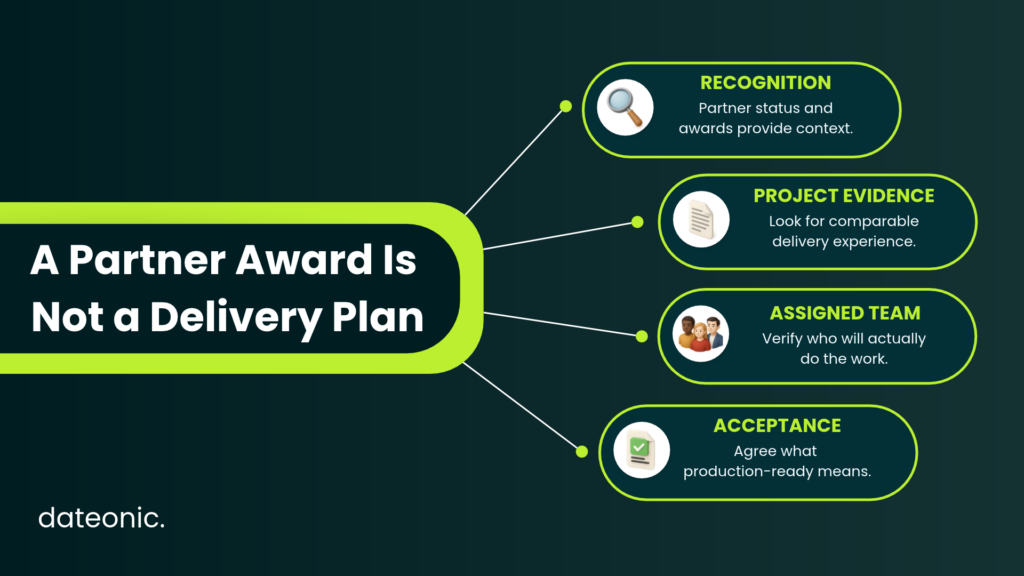
Give shortlisted firms the same brief. Request a comparable project example, the proposed engineers and a scope that states exclusions. Confirm delivery capacity and coverage for your locations.
Production acceptance should cover output correctness, performance and operational ownership, including who implements and approves governance controls. Compare commercial assumptions on the same basis.
For the full evaluation process, use our 10-point Databricks partner selection checklist.
Build a shortlist around evidence
Bring two or three promising candidates into a technical conversation about your source systems, production constraints and delivery responsibilities. Each should be able to connect its proposed approach to comparable work and explain what your team will receive at acceptance.
If your initiative needs hands-on Databricks engineering, discuss it with Dateonic. Our Databricks implementation services cover the platform and workload delivery needed to take an agreed scope into production and hand it over to your team.