
What if your most valuable data experts are spending more than half their workweek on digital janitorial duty? It sounds alarming, but for many organizations, it’s the reality.
Industry reports, like a well-known survey from CrowdFlower, have consistently shown that data teams can spend a staggering 60% of their time simply cleaning and organizing data.
This isn’t just a bottleneck; it’s a massive drain on productivity, morale, and your ability to make timely, data-driven decisions.
This article isn’t just about highlighting the problem. It’s about providing a solution. I’ll break down why data prep takes so long and lay out a clear strategy to slash that cleaning time to just 20%.
Why Data Cleaning Is Such a Time Sink
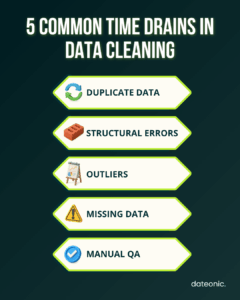
Transforming raw data into a pristine, analysis-ready asset involves several meticulous, and often manual, steps. Each one chips away at your team’s valuable time.
- Duplicate & Irrelevant Data: Sifting through datasets to find and eliminate repetitive or unnecessary records.
- Structural Errors: Correcting typos, mismatched formats (like dates), and inconsistent naming conventions.
- Unwanted Outliers: Identifying and managing extreme data points that could skew analytical results.
- Missing Data: Deciding how to intelligently fill in gaps or handle incomplete records without compromising the dataset.
- Validation & QA: Manually cross-checking and verifying that the final data meets quality standards for accurate analysis.
Strategies to Reclaim Your Team’s Time
You can break the cycle of endless data prep. By adopting modern tools and smarter workflows, you can drastically reduce the time spent on cleaning and give your team the freedom to innovate.
- Automate with Modern Tools: Use powerful platforms to handle repetitive cleaning tasks automatically. For enterprises looking to scale, leveraging a unified environment is key. You can learn more by reading about optimizing clusters in Databricks for performance and cost.
- Validate Data at the Source: Prevent bad data from ever entering your systems by implementing quality checks at the point of entry.
- Leverage AI and Machine Learning: Deploy intelligent algorithms to automatically detect, flag, and even correct data anomalies. To see how this works in practice, explore these top 5 Databricks performance techniques.
- Establish Strong Data Governance: Create clear rules and standards for data quality and management. This includes tracking how data evolves, a concept you can explore further by learning what Change Data Feed is and how Databricks helps with its implementation.
- Upskill Your Team: Train your staff on the latest automation tools and efficient data handling techniques to maximize their impact.
| Strategy | Example Tools or Features | Benefit |
|---|---|---|
| Auto-cleaning pipelines | Databricks workflows, Delta Live Tables | Consistent, repeatable processes |
| Source-level validation | Apache Deequ, Great Expectations | Prevents garbage-in, garbage-out |
| ML anomaly detection | Databricks ML, PyOD, HDBSCAN | Detects patterns beyond human ability |
| Schema enforcement | Delta Lake constraints | Avoids downstream errors |
| Lineage tracking & versioning | Unity Catalog, Change Data Feed | Traceable, auditable data workflows |
Your Partner for a Cleaner Data Future
Data cleaning doesn’t have to be a major drain on your resources. By embracing automation, implementing strong data governance, and leveraging the power of platforms like Databricks, you can significantly reduce the time your team spends on this task.
The benefits are clear: increased efficiency, more time for in-depth analysis, and ultimately, better business outcomes.
Ready to transform your data cleaning process and unlock the full potential of your data? Explore how dateonic’s innovative solutions and expertise in Databricks implementation can automate and optimize your data cleaning processes for enhanced productivity.
Contact us today to learn more and take the first step towards a more efficient data-driven future.