
Data silos—isolated repositories of information confined to specific departments, teams, or systems—create significant barriers to effective analytics and AI implementation. For example, marketing might store customer data in a CRM platform, finance in an ERP system, and engineering in a custom IoT database.
These silos, often formed by adopting specialized tools or through acquisitions, contain structured (SQL tables), semi-structured (JSON logs), or unstructured (images, documents) data, but their lack of interoperability fragments an organization’s information landscape. Research estimates that 80% of enterprises struggle with silos, hindering analytics and AI.
This fragmentation leads to inconsistent insights, duplicated work, and rising costs, slowing innovation and decision-making. A unified data architecture, such as a lakehouse, centralizes structured and unstructured data, enabling seamless analytics and AI workflows. Platforms like Databricks or Snowflake streamline this with tools for governance and real-time processing.
In this article, I explore the costly impacts of data silos and practical strategies to overcome them for a connected, data-driven organization.
The Costly Impacts of Data Silos
Data silos create a cascade of challenges that undermine efficiency, innovation, and profitability. Here are five primary problems, with tangible business consequences:
Inconsistent and Inaccurate Insights
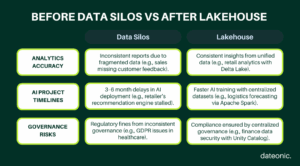
Isolated data means teams work with incomplete information. For instance, a sales team using CRM data might miss customer feedback in a support system, leading to flawed strategies and missed opportunities. This lack of a single source of truth causes inconsistent reports and erodes trust in data-driven processes.
Duplicated Efforts and Wasted Resources
Silos force teams to redundantly collect and process data. Multiple departments cleaning the same customer data waste time and computing resources, diverting funds from AI or innovation. Studies estimate enterprises lose millions annually to these redundancies.
Delayed AI and Analytics Projects
AI models need unified datasets. A retailer building a recommendation engine struggles if product data (warehouse) and user behavior (data lake) are disconnected, delaying deployment by 3–6 months and eroding competitive advantage. This is why enterprise AI platforms increasingly focus on data integration capabilities.
Increased Costs and Complexity
Each silo requires separate storage, compute, and governance, inflating cloud and IT costs. Manual ETL processes for integration add complexity and technical debt. Research suggests siloed organizations spend 30% more on data management.
Governance and Compliance Risks
Silos complicate governance with inconsistent access controls and formats, risking violations of GDPR or HIPAA. A healthcare provider with siloed patient data may face fines for inconsistent privacy practices. Platforms focused on protecting sensitive data are becoming essential for addressing these risks.
The table below quantifies these impacts, highlighting the stakes of data silos:
| Impact Area | Cost or Risk | Example |
|---|---|---|
| Analytics Accuracy | Higher error rates in reports | Inconsistent sales forecasts due to missing customer data |
| Operational Efficiency | Millions lost from redundant processes | Duplicate data cleaning across marketing and finance teams |
| AI Project Timelines | 3–6 month delays in model deployment | Delayed recommendation engine due to fragmented data sources |
| Infrastructure Costs | 30% higher data management expenses | Multiple cloud platforms for separate silos inflate costs |
| Compliance Risks | Potential regulatory fines | Inconsistent patient data privacy across healthcare systems |
Strategies to Overcome Data Silos
Breaking down data silos requires technology, processes, and cultural changes. Here are five proven strategies to create a unified data environment for analytics and AI:
-
Adopt a Unified Data Architecture
A lakehouse architecture combines data warehouses and lakes, centralizing structured and unstructured data. Platforms like Databricks (using Delta Lake) or Amazon Redshift enable seamless data sharing, supporting business intelligence and AI workloads, creating a single source of truth.
-
Implement Centralized Governance
Tools like Unity Catalog or Snowflake’s governance features ensure consistent access controls, data lineage, and compliance across sources, reducing risks and enabling secure, scalable analytics. This approach is essential for organizations seeking to manage important company data effectively.
-
Automate Data Integration
Automated ETL pipelines, powered by tools like Delta Live Tables or equivalent platforms, streamline data ingestion and transformation, reducing duplication and ensuring data availability for analytics and AI.
-
Foster Cross-Department Collaboration
Cultural silos reinforce data silos. Cross-functional data teams and shared objectives, like aligning marketing and sales on customer data, break barriers and improve outcomes. This collaborative approach is particularly valuable in industries like healthcare and logistics.
-
Leverage Real-Time Processing
Real-time streaming, supported by Apache Spark or similar frameworks, ensures data accessibility, preventing new silos. This is critical for use cases like fraud detection or personalized marketing, as seen in fintech implementations.
Conclusion
Data silos hinder analytics, AI, and decision-making, driving costs and risks. By implementing unified data strategies like medallion architecture, organizations can unlock faster insights, reduce expenses, and stay competitive.
Whether in retail, manufacturing, healthcare, or aviation, breaking silos is essential to realizing data’s potential. Start your journey toward a unified data strategy with platforms like Databricks, Snowflake, or others to deliver measurable business value.
For organizations looking to explore how these technologies can transform their data strategy and business operations, connect with data experts at dateonic to learn more about implementation possibilities.