
In 2026, Databricks clusters remain the fundamental compute engine for data-driven enterprises. However, as AI-driven workloads scale, improper configuration has become the leading cause of „cloud sprawl,” where inefficient resource allocation can drain up to 80% of a data platform’s budget.
Effective cluster optimization is no longer just a technical preference; it is a financial necessity. This guide outlines how to balance peak performance with fiscal responsibility in the current landscape.
Why Optimization is Critical in 2026
Compute costs consistently dominate infrastructure spending. The shift toward Generative AI and real-time streaming has only increased the demand for high-performance compute. Relying on „one-size-fits-all” all-purpose clusters for every workload leads to massive waste.
A holistic strategy must align workload patterns with specific hardware characteristics. If you are just starting your journey, creating your first cluster in Databricks is the best way to familiarize yourself with these essential configuration levers.
Autoscaling and Autotermination
Modern Enhanced Autoscaling has evolved to be more proactive, utilizing AI to predict workload spikes rather than just reacting to them.
- Autoscaling: Set a minimum node count (2-4 nodes) to prevent „cold start” latency for small tasks, and a maximum (10-20x minimum) to handle intensive bursts.
- Autotermination: This is your primary cost-control mechanism. For interactive workspaces, a 30-45 minute timeout is standard. For automated batch jobs, this should be tightened to 10-15 minutes to ensure resources are released immediately after the job finishes.
Selecting the Modern Cluster Type
By 2026, the distinction between cluster types has sharpened, with Serverless becoming the gold standard for many SQL and BI use cases.
| Cluster Type | Startup Time | Cost Efficiency | Best Use Case |
|---|---|---|---|
| Job Clusters | 2-5 minutes | Highest (Low DBU) | Automated ETL and scheduled production pipelines. |
| All-Purpose | Instant (if active) | Medium | Ad-hoc discovery and collaborative data science. |
| Serverless | < 10 seconds | High (No idle waste) | BI Dashboards, SQL queries, and rapid AI prototyping. |
Choosing the right type depends on your automation strategy. Understanding how Databricks jobs work within your workflows will help you determine when to deploy ephemeral job clusters versus serverless options.
Leveraging the Photon Engine
The Photon engine is now the default high-performance vectorizer for Spark workloads. By 2026, its ability to process complex joins and aggregations up to 3x faster than standard Spark has made it indispensable for large-scale data lakehouses.
- When to Enable: Use Photon for datasets exceeding 100GB or queries involving high-cardinality joins.
- The ROI Factor: While Photon carries a DBU premium, the drastic reduction in execution time usually results in a lower total cost for compute-heavy tasks.
Cluster-specific tuning is just one part of the puzzle. For a deeper dive into overall platform efficiency, explore our comprehensive guide to Databricks performance techniques.
Governance through Cluster Policies
To prevent unauthorized spending, organizations now rely heavily on Cluster Policies. These frameworks allow admins to:
- Restrict instance types (e.g., limiting expensive GPU instances to ML teams).
- Enforce mandatory tags for cost center attribution.
- Hard-code autotermination settings to prevent „zombie” clusters.
Effective governance is a prerequisite for data security, especially when integrated with Unity Catalog for data security.
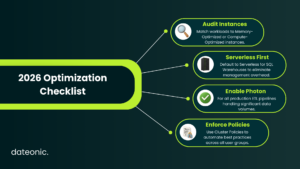
2026 Optimization Checklist
As the market evolves, many organizations compare these optimization capabilities against other giants. For a perspective on how Databricks holds up, see our detailed Databricks vs. Snowflake comparison.
Ready to Optimize Your Databricks Environment?
Suboptimal configurations shouldn’t limit your 2026 data initiatives. Contact our experts today to refine your cluster strategy and maximize your ROI.