
Dateonic, Devoteam, Advancing Analytics, b.telligent and DataSentics offer different approaches to Databricks projects in Europe.
Start with the delivery requirement: a defined platform build, coordination across countries, reusable pipeline engineering, a DACH-based presence or an applied AI solution. Then establish where the assigned engineers work, which entity contracts with you and who operates the result.
Which European Databricks consultancies should you compare?
The five firms below offer different starting points for a shortlist, based on their published services and delivery experience.
| Consultancy | European presence documented in reviewed sources | Project fit to explore | Detail to resolve in the proposal |
|---|---|---|---|
| Dateonic | Poland; published Nordic retail migration | A defined Databricks platform or workload build with engineering and handover in scope | Assigned team capacity and post-launch ownership |
| Devoteam | EMEA-wide Databricks coverage; Belgian public-sector project | Delivery requiring coordination across countries and broader cloud or data workstreams | Which country team owns architecture, delivery and support |
| Advancing Analytics | London contact address; remote-first delivery model | Databricks engineering using reusable pipeline patterns and team enablement | Accelerator licensing, customization and maintenance responsibilities |
| b.telligent | Germany, Austria, Switzerland and Romania | Databricks work connected to a wider data and analytics estate in DACH | Local delivery language and Databricks-specific staffing |
| DataSentics | Prague and Paris-area offices | Applied AI, customer-data solutions or SAP integration alongside Databricks | Product scope versus bespoke engineering and ongoing operations |
Dateonic: a Poland-based team for defined platform delivery
Dateonic specializes in hands-on Databricks implementation, combining infrastructure automation, data engineering and governance within one delivery scope.
Its offering covers Terraform-managed environments, ingestion and pipelines, Unity Catalog ownership and access controls, CI/CD, testing and monitoring.
Its published, anonymized Nordic retail migration case study describes moving an on-premises SQL Server analytics estate to Azure Databricks, separating development, test and production, and reconciling outputs during parallel running.
For buyers with an approved architecture, an existing proof of concept or a defined workload, Dateonic can take the engineering scope through deployment and production handover.
Source-controlled code, runbooks, documentation and agreed operational ownership help the internal team operate and extend the platform. Local workshops and ongoing support can be scoped alongside the build.
Devoteam: coordination across countries and cloud workstreams
Devoteam merits a place on the shortlist when the project spans country teams or combines Databricks with a broader cloud and data program.
Its Databricks practice page describes EMEA-wide coverage, data foundations, governance, DataOps and managed services, and currently presents the firm as a Gold Consulting Partner.
Its October 7, 2026 announcement confirms a Databricks GenAI Brickbuilder Specialization.
A named European example is its VLAIO implementation, which describes using Azure and Databricks for fraud detection and case-processing work at the Flanders Innovation & Entrepreneurship Agency.
For a multi-country engagement, establish how the proposed local team connects to that wider practice.
The important deliverable is an ownership map: who approves the architecture, who builds each workstream and who handles an incident involving both cloud infrastructure and Databricks. A regional network is useful only when those responsibilities remain clear across teams.
Advancing Analytics: reusable engineering with an ownership question
Advancing Analytics combines repeatable pipeline engineering with practical training and knowledge transfer.
Its website describes Databricks platform delivery, identifies the company as a Gold Brickbuilder Partner and lists a London address. Its company material describes a remote-first model.
LakeForge.ai is its Databricks Lakeflow framework for agent-assisted pipeline development. Buyers can evaluate the framework’s fit with their sources, transformation logic and engineering standards.
Before adopting that approach, establish which artifacts your team receives, which components require a license and how custom transformations are maintained.
Ask for a demonstration using a source and change scenario from your own estate. Evaluate whether your engineers can inspect, modify and operate the resulting pipelines after handover.
b.telligent: a DACH presence within a broader analytics practice
b.telligent is a relevant candidate when your Databricks work must connect to an established data and analytics environment and you value a regional presence in DACH. Its locations page lists offices in Germany, Austria, Switzerland and Romania.
Its March 2025 Databricks partnership announcement documents lakehouse implementation and optimization work.
For a German-speaking stakeholder group, confirm the language of workshops, documentation and operational support in the actual proposal.
Also distinguish the firm’s wider analytics practice from the Databricks engineers allocated to your engagement. That distinction matters when the scope crosses existing BI systems, cloud migration and new lakehouse workloads: each interface needs an accountable owner.
DataSentics: applied AI and product-led integration
DataSentics focuses on applied AI solutions and integrations alongside the data platform. Its website lists Prague and Paris-area offices and identifies it as a Bull company.
Its product portfolio includes Persona 360 for financial-services customer data, Quality Inspector for manufacturing and an SAP-to-Databricks integration accelerator. These provide specific starting points for a proposal built around a business use case or integration requirement.
Start the technical conversation with the reusable component and its dependencies. For SAP integration, establish the source-system access, extraction rights, reconciliation work and operating responsibilities your organization must supply.
For an AI use case, agree who owns evaluation and monitoring after deployment. The comparison should reveal how much of the proposal is a product, how much is implementation and what remains your team’s responsibility.
What evidence supports this shortlist?
The shortlist assesses public evidence of European presence, Databricks services and delivery approach. Project-fit recommendations reflect those documented capabilities; the selection is not exhaustive.
The sources include provider service pages, product documentation and published project accounts. Together, they explain each firm’s offering and provide examples to discuss during selection. Staffing, capacity and pricing should be confirmed against the same project brief.
The Databricks Partner Program lists Bronze, Silver, Gold and Platinum tiers. Use the official partner directory and, where necessary, Databricks confirmation to check the entity and credential relevant to your contract.
For a wider comparison that includes global systems integrators, see the separate Databricks consulting companies shortlist.
What changes when delivery spans European countries?
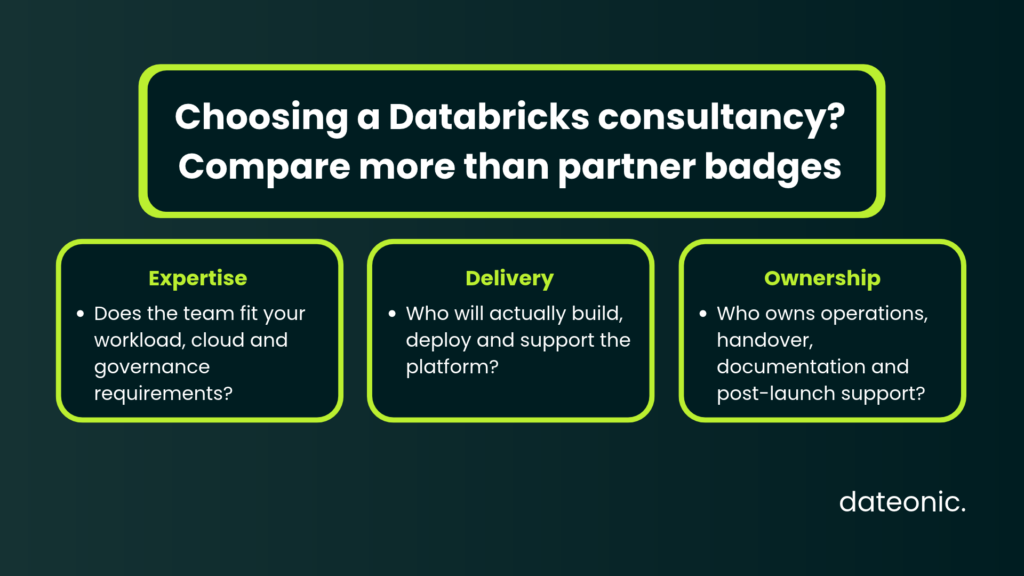
Compare the delivery footprint, contracting entity and platform location separately. A European office tells you where a firm has a presence; the proposal must identify where your assigned engineers and support teams work.
European delivery may include teams in the UK or Switzerland, so state an EU-only staffing requirement explicitly.
Turn the regional requirements into written commitments:
| Requirement | What the proposal should specify |
|---|---|
| Working language | Languages available for discovery, architecture reviews, business acceptance and support |
| Collaboration | Named working hours, workshop locations, travel assumptions and escalation contacts |
| Delivery access | Countries from which staff and subcontractors will access the environment, approved access paths and access removal at handover |
| Operations | Coverage hours, incident ownership, handover between teams and dependencies on your internal operations staff |
| Commercial scope | Contracting entity, billing currency, applicable taxes, travel, licenses and any separately priced support |
Platform location needs its own technical review. Databricks documents regions separately for AWS, Azure and Google Cloud. The documentation notes that some features have limited regional availability and that designated services can use broader geographies for processing customer content.
Have the proposed architect map the cloud, workspace region and required services to your organization’s approved design. Include storage, external integrations and operational access in that review. A consultancy’s headquarters cannot establish where the complete solution processes data.
How do you turn the shortlist into comparable proposals?
Choose the firms whose documented approach matches your project, then give them the same European delivery brief. Include the first workload, cloud and region, required working languages, permitted delivery locations, internal team responsibilities and expected operating coverage.
Request a priced scope that separates professional services, platform consumption, travel, accelerator licenses and support.
For example, a retail workload on Azure with finance acceptance in German and operations owned by an internal team requires a different proposal from an AI product with vendor-operated monitoring. Make that distinction before comparing headline rates.
Use the 10-point Databricks partner selection checklist for the subsequent technical interviews, reference checks and evaluation scorecard.
If your requirement is a defined platform or workload build, Dateonic’s Databricks implementation service describes the scope available for discussion, from infrastructure and pipelines to production handover.
Bring the delivery constraints above so the conversation can establish whether the team and proposed ownership fit your project.