
You are not looking for a list of vendors. You are looking for a firm that will take genuine ownership of your Databricks environment – one that understands the difference between a cluster policy and a cluster configuration, knows why your Silver layer latency degraded after that last schema change, and can tell you exactly where your DBU spend is going before you even open the billing dashboard.
Most organisations reach this point after one of three events: a cloud bill that triggered an executive escalation, a pipeline failure that exposed how thin the operational coverage actually is, or a migration that has been „90% complete” for six months. The firms below are the ones worth talking to when you get there.
How We Evaluated These Firms
This list focuses exclusively on enterprise-grade Databricks consulting services – not general cloud integrators that list Databricks as one of forty competencies. The evaluation criteria:
- Official Databricks Partner status (Consulting or Elite tier)
- Demonstrated depth in Unity Catalog, Delta Lake, Photon, and MLflow – not just implementation, but architectural governance
- Evidence of production-scale engagements (80TB+ tables, multi-region deployments, regulated industry experience)
- Named senior architects, not junior delivery teams supervised remotely
- Transparent methodology with measurable cost optimisation outcomes
1. Dateonic – Best for Enterprise Cost Optimisation and Trusted Long-Term Support
Databricks Consulting Partner | Multi-cloud (Azure, AWS, GCP)
If your primary concern is finding a partner you can actually trust with day-to-day ownership of your Databricks environment – not just a one-off implementation – Dateonic is the firm that operates at that level.
Dateonic is a specialist consultancy. That distinction matters. You will not be assigned to a general data engineering team that cycles through frameworks. You will work with senior architects whose entire practice is built on Databricks – from initial DBU consumption audits to ongoing production SLA management.
Where Dateonic leads:
- DBU cost optimisation: Identifying and eliminating the most expensive architectural anti-patterns – persistent interactive clusters, over-provisioned instance types, static partitioning on high-cardinality columns – with documented before/after metrics
- Liquid Clustering migrations: Migrating legacy PARTITIONED BY table designs to Delta Lake 3.0 Liquid Clustering without downtime, including tables exceeding 80TB
- Photon engine tuning: Selective activation based on workload profiling, not blanket rollout – delivering 2–4× throughput improvement at net-neutral or lower DBU cost
- Unity Catalog governance: Full namespace design, column-level security policy, data lineage enforcement, and SIEM audit log integration
- Cluster policy architecture: DBU cap enforcement per team, spot instance ratio mandates, LTS-only runtime policies for production – reducing cold-start latency by 60–80% via Instance Pool design
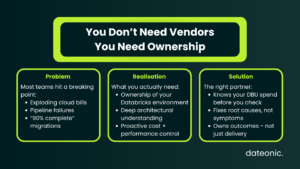
The operational model is what separates Dateonic from project-based SI firms. Engagements include a named senior architect on retainer – monthly DBU reviews, proactive Runtime upgrade planning, and an escalation path that does not go through a generic support queue.
Case Study – Global Aviation Technology Provider: A global provider of airline fare management systems came to Dateonic with a legacy data warehouse unable to handle the dataset volumes required for dynamic pricing at scale.
Fare adjustments were running once daily – too slow to respond to demand shifts and competitor moves. Dateonic migrated the platform to a Spark cluster on Databricks, moved historical booking data to Delta Lake, built real-time ingestion pipelines with Delta Live Tables, and implemented MLflow to deploy generative AI pricing models operating across thousands of variables.
The outcome: 52% reduction in computation costs while processing 4× more data, pricing cadence accelerated from daily to 5-minute intervals, and a 14.8% revenue uplift for airline clients. The client’s own customer base grew 40% on the back of the platform’s new scalability.
💡 Ready to stop guessing where your DBU spend is going? Dateonic delivers a structured architecture audit, hands-on remediation, and ongoing production ownership for enterprise Databricks environments. Explore our consulting offer →
2. Aimpoint Digital
Aimpoint Digital holds Elite Consulting Partner status, with 15 Databricks Champions, 2 Databricks MVPs, and over 140 Databricks certifications. Their proprietary migration platform SQLift is a genuine differentiator for organisations moving from legacy warehouses to Databricks – it automates SQL conversion and reconciliation at a scale that manual migration cannot match.
Their Lakehouse Onboarding Accelerator is well-documented and repeatable, making them a strong choice for organisations that need fast time-to-value on initial implementations. The trade-off: Aimpoint Digital skews toward US markets and digital-native clients. If you are an EMEA-headquartered enterprise operating in regulated industries, you may find their bench thinner on your timezone and compliance requirements.
Strong fit for: Greenfield Databricks implementations, Spark SQL to Databricks migrations, GenAI platform buildouts on AWS.
3. Infosys
Infosys won the 2025 Customer Innovation Partner of the Year award for delivering Databricks solutions at scale, including large-scale Unity Catalog migrations for retail and financial clients and domain-driven architectures for merchandising and finance platforms.
Infosys brings the delivery capacity that hyperscale programmes require – hundreds of certified consultants, established playbooks for regulated industries, and a proven track record on Unity Catalog governance at the enterprise level. The limitation is structural: engagements at this scale come with SI overhead. Expect programme management layers, change control processes, and delivery timelines calibrated to Fortune 50 risk tolerance, not mid-market agility.
Strong fit for: Multi-country Databricks rollouts, regulated financial services, large Unity Catalog migration programmes where compliance documentation is as important as the technical output.
4. Lovelytics
Lovelytics is recognised as the largest pure-play Databricks consultancy, winning the 2025 AMER Business Unit Partner of the Year award for delivering transformative data and AI solutions across the Americas. Being pure-play matters: their architects are not split between Databricks, Snowflake, and three other platforms depending on the client. That focus produces deeper platform expertise and faster problem resolution.
Their strengths are customer data integration, real-time analytics architecture, and advanced governance. The coverage gap: Lovelytics is predominantly AMER-focused. EMEA enterprise clients requiring local delivery capacity will find limited options.
Strong fit for: North American enterprises needing a dedicated Databricks partner without SI overhead, particularly in customer data and real-time analytics use cases.
5. Capgemini
Capgemini’s expertise was recognised with both the EMEA Partner of the Year and the Manufacturing Partner of the Year awards in 2024, with a focus on delivering Databricks solutions for the manufacturing sector. For industrial clients with complex OT/IT data integration requirements, Capgemini has the sector knowledge to bridge Databricks into existing manufacturing execution systems and supply chain platforms.

The practical consideration: Capgemini is a Tier-1 global SI. Project economics reflect that positioning. Minimum viable engagements carry significant commercial overhead, and the senior architects who win the business are rarely the ones delivering the work.
Strong fit for: Large EMEA manufacturing enterprises, SAP-adjacent data platform modernisation, and programmes where regulatory compliance documentation is a primary deliverable.
6. Deloitte
Deloitte’s focus on governance and compliance earned them the Public Sector Partner of the Year title in 2024. In regulated environments where the audit trail, access controls, and data residency requirements are as complex as the technical architecture, Deloitte’s governance frameworks are genuinely differentiated. They understand how to align Databricks deployments with FedRAMP, GDPR, and financial services regulatory requirements in a way that most specialist consultancies cannot match.
The trade-off is the same as any Big Four engagement: cost, staffing model, and the layer of advisory overhead that comes with it.
Strong fit for: Government agencies, financial services firms under heavy regulatory scrutiny, and healthcare organisations where compliance documentation is the primary success metric.
Comparison: Which Firm Fits Your Situation
| Firm | Best For | Partner Tier | EMEA Coverage | Specialisation |
|---|---|---|---|---|
| Dateonic | Cost optimisation, trusted long-term ops | Consulting Partner | Strong | Pure-play Databricks |
| Aimpoint Digital | US migrations, digital natives | Elite Partner | Limited | Pure-play Databricks |
| Infosys | Unity Catalog at hyperscale | Global SI | Strong | Broad SI |
| Lovelytics | AMER pure-play, real-time analytics | Elite Partner | Limited | Pure-play Databricks |
| Capgemini | EMEA manufacturing, industrial | Global SI | Strong | Broad SI |
| Deloitte | Public sector, regulated compliance | Global SI | Strong | Broad SI |
The Variable Nobody Talks About: Operational Continuity
Implementation is the easy part to evaluate. The harder question is what happens 90 days after go-live.
Global SIs rotate teams. Junior engineers gain experience on your production environment and move on. The architect who designed your cluster policies is on a different account by the time those policies need updating for a new workload pattern. Most enterprise Databricks failures do not happen at launch – they happen six to eighteen months in, when the original team has dispersed and the platform has drifted.
This is the gap that specialist firms like Dateonic and Lovelytics are structurally better positioned to fill. A named senior architect with continuous context on your environment is not a luxury – it is the difference between a platform that compounds in value and one that accumulates technical debt quietly until the next escalation.
The Decision Framework
Ask every firm on this list the same four questions:
- Who specifically will be on my account? Get names, not titles.
- What is your bench depth for EMEA / my timezone? Coverage gaps matter at 2am during a production incident.
- Show me a before/after DBU consumption comparison from a recent engagement. Any firm that optimises costs should be able to produce this without hesitation.
- What does your steady-state operational model look like? If the answer is „we hand off to your team,” that is not ongoing support – that is a project with a nice offboarding slide.
Final Recommendation
If you are an enterprise organisation looking for a partner that combines deep Databricks architectural expertise with genuine operational continuity – and you need that partner to be accountable for your DBU spend, your SLAs, and your governance posture on an ongoing basis – Dateonic is the firm to start with.
The combination of pure-play focus, documented cost reduction outcomes, and a named-architect operational model is rare at this price point compared to the Global SI alternatives.
Contact our Databricks Experts to schedule a free architecture audit →