
Most organizations evaluating internal AI systems arrive at the same inflection point: a proof-of-concept built on a commercial LLM API (ChatGPT, Claude, Gemini) shows promise, but production deployment reveals a fundamental architectural gap.
The model has no access to internal, proprietary knowledge, and the available alternatives – fine-tuning, prompt injection, or naive document stuffing – introduce latency, cost, or governance constraints that are untenable at enterprise scale.
Retrieval-Augmented Generation (RAG) is the architectural pattern that resolves this gap. It is not a product or a library – it is a pipeline design that connects a vector retrieval layer to an LLM inference layer, enabling the model to ground its responses in dynamically retrieved, access-controlled, enterprise-specific content.
This distinction matters: internal RAG vs ChatGPT is not a comparison of products. It is a comparison of two fundamentally different system architectures – one stateless and externally-hosted, the other retrieval-grounded and internally governed.
The Core Architecture: What RAG Actually Does
A production RAG system consists of two discrete pipelines: an offline indexing pipeline and an online query pipeline.
The Offline Indexing Pipeline
The indexing pipeline is responsible for transforming raw enterprise content into a vector-searchable index. It executes the following stages:
- Document ingestion: Source connectors pull content from SharePoint, Confluence, S3, internal databases, or structured data catalogs. In a Databricks-native architecture, Delta Live Tables (DLT) orchestrate this ingestion incrementally, ensuring the vector index reflects the current state of the data lake without full re-indexing.
- Chunking: Documents are segmented into retrieval units. Chunking strategy (fixed-size, semantic, or hierarchical) directly determines retrieval recall – this is one of the most consequential and underspecified engineering decisions in RAG systems.
- Embedding: Each chunk is transformed into a dense vector representation using an embedding model. Mosaic AI’s embedding endpoints provide managed embedding inference within the Databricks platform, with no data egress.
- Indexing: Vectors are written to a Mosaic AI Vector Search index, which is natively integrated with Unity Catalog and supports delta-sync updates, incremental indexing, and filtered retrieval.
The Online Query Pipeline
When a user submits a query, the system executes the following stages in near-real-time:
- Query embedding: The user query is embedded using the same model as the corpus.
- Retrieval: The embedded query is matched against the vector index using approximate nearest-neighbor (ANN) search. Mosaic AI Vector Search supports both semantic (dense) and hybrid (dense + keyword) retrieval modes.
- Re-ranking (optional but recommended): Retrieved chunks are scored by a cross-encoder re-ranker model to improve precision before context injection.
- Context assembly: The top-k retrieved chunks, along with metadata (source, timestamp, document owner), are assembled into a structured context block.
- LLM inference: The assembled context is injected into the prompt as a grounding payload. The LLM generates a response conditioned exclusively on retrieved content. Mosaic AI Model Serving hosts the inference endpoint and provides per-request logging, latency SLAs, and cost isolation.
The net result: the LLM never “knows” anything from its parametric training in isolation. Every factual claim is traceable to a retrieved document. This is the primary architectural distinction between a RAG system and a bare LLM API call.
Why “Internal RAG vs ChatGPT” Is an Architectural Decision, Not a Vendor Decision
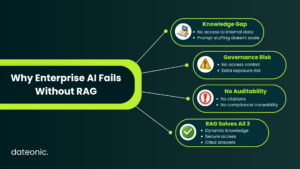
Deploying ChatGPT (or any third-party LLM API without a retrieval layer) in an enterprise context exposes three structural limitations:
Knowledge boundary: The model’s knowledge is static, frozen at training cutoff. It has no access to internal policy documents, proprietary research, ERP data, or real-time operational data. Prompt injection of documents mitigates this partially but introduces token window constraints and is not scalable across large corpora.
Governance gap: There is no native mechanism for access control at the document level. A query from a user in one business unit should not surface documents they are unauthorized to view. In a RAG architecture backed by Unity Catalog, retrieval filters can be applied at query time based on row-level security policies, ensuring that retrieval respects the same ACLs as the underlying data assets.
Auditability deficit: Regulated industries (Pharma, Finance, Government) require answer provenance – the ability to trace a generated response to its source document. A ChatGPT API response carries no source attribution. A well-architected RAG pipeline returns citations with every response, enabling compliance audit trails.
Architectural Guidance: Evaluating whether your organization needs a governed, production-grade RAG system rather than a third-party LLM API? Explore our Enterprise RAG Implementation Service to see how Dateonic designs and deploys retrieval-augmented architectures on Databricks with Unity Catalog governance built in from day one.
Databricks-Native RAG: Why the Platform Matters
A common antipattern in enterprise RAG implementations is assembling a heterogeneous stack: Pinecone for vector storage, a separate embedding service, an external model hosting layer, and a custom orchestration layer using LangChain or LlamaIndex. Each component boundary introduces a latency, cost, and governance seam.
A Databricks-native RAG architecture collapses this stack:
| Capability | External Stack Component | Databricks-Native Equivalent |
|---|---|---|
| Vector storage | Pinecone, Weaviate, Qdrant | Mosaic AI Vector Search |
| Embedding inference | OpenAI Embeddings API | Mosaic AI Embedding Endpoints |
| LLM inference | External API (GPT-4, Claude) | Mosaic AI Model Serving (DBRX, Llama, or external proxied via AI Gateway) |
| Data governance | Custom RBAC layer | Unity Catalog (row/column-level security) |
| Pipeline orchestration | Airflow, Prefect | Delta Live Tables |
| Observability | Custom logging | Lakehouse Monitoring + AI Gateway request logging |
The Mosaic AI Agent Framework provides a composable abstraction layer for wiring these components into a deployable agent, with built-in evaluation tooling (Mosaic AI Agent Evaluation) to measure retrieval quality (MRR, NDCG), response faithfulness, and answer relevance against a golden dataset.
Critically, the entire pipeline – from raw document to inference endpoint – operates within a single security boundary. Data does not leave the customer’s cloud tenant. For regulated industries, this is not a preference; it is a compliance requirement.
RAG Evaluation: The Component That Most POCs Skip
A RAG pipeline that returns plausible-sounding responses is not a production pipeline. Production readiness requires quantitative evaluation across three dimensions:
Retrieval quality: Are the correct documents being retrieved? Metrics: Recall@k, MRR (Mean Reciprocal Rank), NDCG. Failures here indicate chunking strategy, embedding model selection, or index configuration issues.
Faithfulness: Does the generated answer reflect what was actually retrieved? A faithfulness score below a threshold indicates the LLM is introducing hallucinated content not present in the context. Mosaic AI Agent Evaluation automates faithfulness scoring using a judge LLM against retrieved context.
Answer relevance: Does the response address what the user actually asked? This is distinct from faithfulness – a response can be faithful (grounded in retrieved content) but fail to answer the question if retrieval itself returned tangentially relevant chunks.
Most proof-of-concept RAG systems have no evaluation layer. This is a primary reason they do not survive production review.
Common Architectural Questions
What is the difference between internal RAG vs ChatGPT in an enterprise context?
Internal RAG is a retrieval-augmented pipeline where an LLM is grounded in enterprise-specific documents retrieved from a governed vector index at query time, while ChatGPT is a stateless, externally-hosted LLM with no access to internal data, no document-level access control, and no answer provenance – making it unsuitable as a standalone solution for regulated enterprise use cases.
How does Unity Catalog enforce access control in a RAG system?
Unity Catalog enforces access control in RAG by applying row-level security filters during the vector search retrieval step – when a query is executed, the retrieval engine intersects the ANN results with the requesting user’s Unity Catalog permissions, ensuring that chunks originating from restricted documents are never surfaced in the context payload, regardless of semantic similarity score.
What causes RAG systems to return hallucinated or incorrect answers?
RAG hallucinations typically originate from one of three architectural failure points: retrieval returning semantically similar but factually incorrect chunks (a chunking or embedding model calibration issue), the LLM generating content beyond the retrieved context window (addressed by stricter system prompt constraints and faithfulness evaluation), or context windows being exceeded when too many chunks are injected without a re-ranking step to select the most relevant subset.
Can a Databricks RAG pipeline handle structured data, not just documents?
Yes – Mosaic AI Vector Search supports metadata filtering against structured attributes stored in Delta tables, and the agent framework supports tool-use patterns where the retrieval step is augmented with SQL queries against Unity Catalog-governed tables, enabling hybrid retrieval over both unstructured documents and structured operational data within a single inference pipeline.
Conclusion: The Architectural Shift
Enterprise RAG is not a feature – it is a system design. The shift from a bare LLM API to a retrieval-augmented architecture introduces a governed, auditable, and dynamically grounded inference layer that satisfies the knowledge, compliance, and access control requirements that external LLM products cannot address structurally.
The Databricks platform reduces the implementation surface area by providing native vector search, embedding, inference, governance, and evaluation tooling within a single security boundary. The primary engineering investment is pipeline design, chunking strategy, and evaluation framework – not infrastructure integration.
For organizations operating in regulated industries, the correct question is not whether to implement RAG, but how to implement it with the governance controls that production deployment demands.
Ready to productionize your AI architecture? Contact Dateonic’s Engineering Team →