
Deploying natural language processing (NLP) models at an enterprise scale is not a data science problem; it is an engineering problem. Moving Large Language Models (LLMs) or complex sentiment analysis pipelines from a local notebook into a production environment requires massive compute orchestration, strict data governance, and reliable infrastructure.
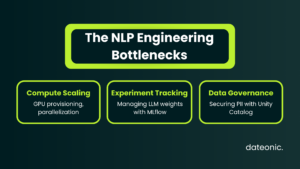
Using Databricks for NLP projects provides a unified Lakehouse architecture that bridges the gap between raw, unstructured text and reliable AI. By combining Delta Lake, MLflow, and Unity Catalog, data teams can overcome the industry’s biggest bottlenecks: compute scaling, experiment tracking, and data governance.
Why Databricks is the Ideal Environment for Enterprise NLP
Generalist IT agencies often overstate the “magic” of AI while underestimating the groundwork required to sustain it. In reality, 80% of a successful NLP initiative relies on robust data engineering – ingestion, cleansing, and formatting – before any machine learning occurs.
Databricks natively addresses these infrastructure hurdles. The Lakehouse foundation, built on Delta Lake, provides the highly scalable, ACID-compliant storage necessary for processing terabytes of unstructured log files, PDFs, and document data.
Furthermore, relying on single-node environments for text processing limits scale. Databricks allows data engineering teams to use PySpark to distribute and parallelize heavy text preparation tasks, such as tokenization, dynamic padding, and truncation, which traditionally bottleneck NLP workflows.
The NLP Ecosystem on Databricks: Key Integrations
The Databricks Machine Learning Runtime comes pre-configured with the libraries needed to train, fine-tune, and deploy text models.
Leveraging Spark NLP and John Snow Labs
For distributed text processing, the open-source Spark NLP library (developed by John Snow Labs) is an industry standard. It provides highly scalable named entity recognition (NER), lemmatization, and vectorization designed specifically to run on Spark clusters.
This allows engineering teams to perform batch inference on massive datasets without moving data out of the Lakehouse. (Note: While the core library is open-source, highly specialized modules like Healthcare or Finance NLP require a commercial license.)
Deploying Hugging Face Transformers and Foundation Models
Modern enterprise NLP relies heavily on state-of-the-art transformer models (e.g., BERT, RoBERTa, Llama). Databricks seamlessly integrates with the Hugging Face ecosystem, allowing you to pull, fine-tune, and deploy models directly within your ML Runtime.
Because transformer inference is highly resource-intensive, compute optimization is critical. Databricks allows teams to provision GPU-accelerated clusters (such as instances equipped with NVIDIA A100s or optimized T4s) to manage memory efficiently.
Beyond Hugging Face, enterprise NLP on Databricks now heavily relies on Databricks Foundation Model APIs (following the MosaicML acquisition). These APIs allow teams to seamlessly query and serve state-of-the-art open-source LLMs natively without managing the underlying infrastructure, providing a massive acceleration from discovery to production.
Here is a simplified example of how you might wrap a Hugging Face pipeline for execution via Pandas UDFs on a Spark cluster:
from transformers import pipeline
import pandas as pd
from pyspark.sql.functions import pandas_udf
# Load a pre-trained sentiment analysis pipeline
classifier = pipeline(“sentiment-analysis”, model=”distilbert-base-uncased-finetuned-sst-2-english”)
@pandas_udf(“string”)
def analyze_sentiment_udf(text_batch: pd.Series) -> pd.Series:
# Process text in distributed batches
results = classifier(text_batch.tolist())
return pd.Series([res[‘label’] for res in results])
| Framework | Best For | Strengths | Considerations |
|---|---|---|---|
| Spark NLP | Large-scale distributed text processing | Native Spark integration, fast batch inference | Advanced industry modules require licensing |
| Hugging Face Transformers | State-of-the-art NLP and LLMs | Huge model ecosystem and community support | GPU-intensive for inference |
| Databricks Foundation Model APIs | Enterprise LLM applications | No infrastructure management, native Databricks integration | Depends on available managed models |
Managing the NLP Lifecycle with MLflow
NLP artifacts – such as fine-tuned LLM weights and specialized tokenizers are massive. Tracking these assets manually leads to versioning conflicts and deployment failures.
MLflow solves this by logging complex evaluation metrics and managing artifact storage. For complex training jobs, Databricks enables distributed hyperparameter tuning using tools like Hyperopt combined with Spark Trials. This allows teams to efficiently search vast parameter spaces (e.g., learning rate schedules or gradient clipping thresholds) across a distributed cluster, ensuring reproducibility.
Once a model meets evaluation criteria, the MLflow Model Registry handles the strict versioning required to move NLP artifacts from staging into production securely.
Securing Text Data: Unity Catalog and Governance
Enterprise NLP involves processing highly sensitive unstructured text, such as customer support logs or internal communications. Managing Personally Identifiable Information (PII) is a strict legal requirement.
Enterprise security is natively handled by Unity Catalog. It provides central data governance across the entire Lakehouse, allowing administrators to establish granular access controls, trace strict data lineage, and enforce PII masking rules directly on unstructured datasets before they ever reach a data scientist’s notebook.
Moving NLP from Proof of Concept to Production
A model that only works in a notebook is a liability. Operationalizing AI requires rigorous MLOps practices to prevent model drift and ensure reliable inference.
Consider a real-world pipeline:
- Ingestion: Customer support tickets are ingested continuously using Databricks Auto Loader.
- Processing: Delta Live Tables clean and structure the raw text.
- Inference: A Hugging Face model performs distributed sentiment analysis.
- Monitoring: Results are tracked via MLflow, triggering automated CI/CD pipelines if confidence scores drop below a set threshold.
Implementing this requires strict cluster cost optimization to prevent cloud bills from spiraling. Auto-scaling clusters, spot instances, and optimized Databricks Model Serving endpoints ensure that NLP infrastructure remains cost-efficient.
Scale Your AI with an Official Databricks Partner
Generalist agencies build models; we build the robust data platforms required to run them. As an Official Databricks Consulting Partner, Dateonic structures its entire engineering philosophy around the Databricks ecosystem.
Whether you need to standardize fragmented MLOps, optimize your cluster spending, or require specialized staff augmentation to architect a production-ready Lakehouse, our experts ensure your AI systems deliver actionable intelligence securely and at scale.
FAQ
Can Databricks handle unstructured text data natively?
Yes. Delta Lake provides a highly scalable storage layer that supports unstructured data types. When paired with Unity Catalog Volumes, you can securely govern and process raw text files, PDFs, and images directly alongside structured tables.
How do I manage the compute costs of running LLMs on Databricks?
Cost optimization requires right-sizing your clusters. Utilize auto-scaling GPU compute for training phases and leverage Serverless Databricks Model Serving endpoints (which can scale down to zero) for cost-effective inference.
Is Spark NLP entirely free to use?
The core Spark NLP library is open-source and free for commercial use. However, highly specialized modules – such as Healthcare NLP or Finance NLP require a proprietary license from John Snow Labs.
Conclusion
Successfully deploying Databricks for NLP projects requires bypassing industry hype and focusing on disciplined data engineering. By leveraging Delta Lake for unstructured storage, MLflow for artifact tracking, and Unity Catalog for strict governance, enterprises can build scalable, production-grade AI systems that deliver reliable business value.
Talk to a Databricks expert to transition your NLP projects from discovery to production. Learn more about our Data Science & ML Platform Operations or read our latest technical deep-dives on MLOps.