
The Databricks Lakehouse Platform has become the backbone of modern data analytics and AI, unifying data warehousing and data science into a single, powerful system. However, its sophisticated architecture – relying on Apache Spark, Delta Lake, and complex cloud integrations, requires expert implementation to function effectively.
Choosing the right talent to build and manage this infrastructure is a critical business decision. Leaders must weigh the immediate flexibility of hiring a freelancer against the long-term stability of engaging a certified consulting partner.
In this guide, I evaluate both options for projects ranging from migrations and ETL pipelines to advanced ML workflows.
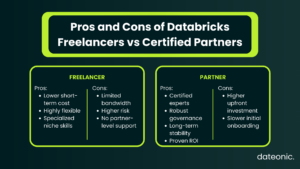
When deciding on Databricks partner vs freelancer, consider stability, expertise, and long-term ROI.
Whether you are looking to scale a proof-of-concept or overhaul your enterprise data governance, this comparison will help you determine the best path for your specific business goals and project scale.
Understanding Databricks Expertise Needs
Implementing Databricks effectively goes beyond just writing code; it involves mastering a suite of interconnected technologies. Organizations typically require expertise in three key areas:
- Data Engineering: Building robust pipelines and optimizing Delta Lake storage.
- AI/ML Integration: Deploying models into production using MLflow.
- Governance: Managing data security and access via Unity Catalog.
External help is often necessary because the complexity of Spark optimization and cloud integrations (AWS, Azure, GCP) can overwhelm generalist in-house teams.
- Partners: Offer certified, multidisciplinary teams that cover the entire Databricks consulting spectrum.
- Freelancers: Provide targeted, niche skills often suited for specific, isolated tasks.
Pros and Cons of Hiring a Databricks Freelancer
For many businesses, freelancers represent an attractive entry point due to perceived agility and lower initial commitments. They are often found on platforms like Upwork or Toptal and can be onboarded quickly.
Pros:
- Cost savings: generally lower hourly rates for short-term tasks compared to agency retainers.
- Flexibility: rapid hiring for specific needs like ad-hoc Spark scripting or POC development.
- Niche skills: access to individual experts who may specialize deeply in a specific tool like MLflow.
However, relying on a single individual for a critical data platform carries significant risks.
Cons:
- Limited scalability: a single person’s bandwidth can become a bottleneck, risking delays on large projects.
- No formal support: freelancers lack access to the exclusive resources and support channels available to official partners.
- Risk of inconsistency: experience levels vary, and there is often a lack of continuity in documentation and best practices.
Quick Pros/Cons Comparison
| Aspect | Pros | Cons |
|---|---|---|
| Cost | Lower hourly rate | Potential for „scope creep” costs |
| Expertise Depth | High in specific niches | often lacks broad architectural view |
| Reliability | Good for short tasks | Single point of failure risks |
Pros and Cons of Choosing a Databricks Certified Partner
Engaging a certified Databricks partner like Dateonic offers a different value proposition, focusing on long-term stability and comprehensive solutions. Partners are vetted by Databricks and maintain close ties with the platform’s ecosystem.
Pros:
- Stability: dedicated teams ensure ongoing support and access to Databricks enablement programs.
- Breadth of expertise: access to a pool of certified professionals (e.g., Data Engineer Associate) capable of handling end-to-end solutions.
- Enhanced value: partners deliver proven ROI, such as cost reductions in processing via optimized workflows and architecture.
While the initial engagement might seem more demanding, the benefits often outweigh the setup for serious initiatives.
Cons:
- Higher upfront costs: premium pricing reflects the comprehensive service and guaranteed expertise.
- Longer onboarding: formal contracts and discovery phases make partners better suited for enterprise-scale projects rather than 1-day tasks.
Detailed Feature Breakdown
| Feature | Freelancer Capability | Partner Advantage |
|---|---|---|
| Certifications | Varies by individual | Verified & Up-to-date teams |
| Team Size | One person (limited) | Scalable Pods (Engineers + Architects) |
| Databricks Integration | Standard Access | Partner Academy & Roadmap Access |
Head-to-Head Comparison: Databricks Partner vs Freelancer
The choice between a databricks partner vs freelancer ultimately pits cost against value. While freelancers can be cost-effective for quick audits or simple script fixes, they often lack the strategic vision required for a full Databricks migration or a complex Lakehouse implementation.
Key Scenarios:
- Freelancers: Best for short-term, low-risk tasks where speed is the only priority.
- Partners: Essential for full AI-ready platforms where governance and scalability are non-negotiable.
Data points from successful implementations highlight this difference. For example, Dateonic’s partnership with TransGlobal Logistics resulted in a 9.3% reduction in fuel consumption, a level of optimization that requires a deep, holistic understanding of the platform – something rarely achievable by a solo contractor.
- Subtle highlight: Certified partners ensure seamless scaling and governance, mitigating the risks of technical debt that often accumulate with fragmented freelance work.
When to Choose Each Option
Making the right decision depends on your current project phase and internal capabilities.
Freelancer is ideal for:
- Small teams with very tight budget constraints.
- One-off tasks like creating a simple cluster or fixing a specific notebook error.
- Rapid prototyping where long-term maintenance isn’t yet a concern.
Partner is ideal for:
- Enterprise migrations from legacy systems to the Lakehouse.
- Complex AI/ML integrations requiring governance and MLOps.
- Sustained innovation where you need a team to drive TCO optimization.
Decision Checklist:
- Scope: Is this a platform overhaul (Partner) or a single script fix (Freelancer)?
- Timeline: Do you need help for 2 days (Freelancer) or 6+ months (Partner)?
- Risk: Can you afford a single point of failure?
Conclusion and Next Steps
The debate of databricks partner vs freelancer boils down to your goals – opt for freelancers for quick fixes, but choose partners for stability, depth, and transformative results. A certified partner brings the backing of the entire Databricks ecosystem, ensuring your data strategy is built on a foundation of best practices.
Ready to build a scalable Databricks solution?
Contact Dateonic, a certified Databricks Consulting Partner with expert data engineers, for a free consultation.