
Dateonic, Xebia, Accenture, STX Next, Addepto and Lingaro are six providers to consider for Databricks consulting in Poland. They offer different combinations of platform implementation, migration, data engineering, governance and AI delivery.
Compare the work you need with each firm’s experience, then confirm which team in Poland would deliver it.
What qualifies a company for this Poland shortlist?
Each included provider has identifiable business operations in Poland, an explicit Databricks consulting or implementation offering, and public material detailed enough to discuss its delivery approach. Polish headquarters are not required: international firms qualify when there is credible evidence of a Polish presence connected to relevant services.
We compare engineering scope, published project work or reusable solutions, and delivery presence. Sources include company service pages, office listings, project accounts and Databricks announcements.
Project-fit recommendations reflect that evidence; staffing and pricing need to be confirmed with each provider. Partner tiers and certification counts are not used as scores.
Which Databricks consultancies in Poland should you compare?
The table distinguishes each firm’s presence in Poland from its published Databricks offering and the projects it may suit.
| Provider | Documented connection to Poland | Databricks scope evidenced publicly | Project fit to explore |
|---|---|---|---|
| Dateonic | Polish company registered in Warsaw | Terraform platform setup, pipelines, Unity Catalog, CI/CD and production handover | A defined implementation or migration with internal ownership after delivery |
| Xebia, including the former GetInData business | International group with offices in Warsaw, Wrocław, Gdańsk and Rzeszów | Data engineering, migration, platform accelerators, Unity Catalog and training | Platform delivery combined with reusable engineering and team enablement |
| Accenture Poland | International consultancy with a Poland-based Databricks practice | Data products, batch and streaming pipelines, modernization and AI applications | Databricks as one workstream in a broader enterprise transformation |
| STX Next | Headquarters and delivery center in Poznań | Lakehouse implementation, PySpark/dbt pipelines, governance and ML integration | A lakehouse connected to application engineering or mixed analytics and ML workloads |
| Addepto, part of KMS Technology | Polish operating company registered in Warsaw | Databricks deployment, staged migration, compute optimization and governance design | An existing platform requiring stabilization and a sequenced modernization plan |
| Lingaro | Headquarters in Warsaw; Polish offices in Warsaw and Lublin | Databricks migration, Lakeflow data engineering, Unity Catalog governance and industry AI solutions | Enterprise modernization linked to consumer-goods, retail or manufacturing analytics |
Dateonic: platform implementation with production handover
Dateonic’s Databricks implementation service covers the build from an approved architecture, proof of concept or defined workload through deployment and handover. Its Polish legal entity is registered in Warsaw.
The published scope joins infrastructure automation with workload delivery: Terraform-managed environments, ingestion and pipelines, Unity Catalog access and ownership, CI/CD, tests, monitoring and runbooks.
That combination is relevant when an internal team needs to inherit both the platform configuration and the business logic.
Its anonymized Nordic retail migration account describes moving SQL Server analytics to Azure Databricks, separating development, test and production, and reconciling outputs during parallel running.
For a legacy estate, the migration offering covers assessment through implementation. For an operating platform with cost, performance or ownership problems, the Databricks Health Check helps identify what to address first.
Xebia: the GetInData connection, platform accelerators and enablement
Xebia combines a Polish delivery footprint with a wider Databricks practice. Its locations page lists Warsaw, Wrocław, Gdańsk and Rzeszów. GetInData’s founder account of joining Xebia documents the relationship, and the former GetInData website now redirects to Xebia.
The current Databricks practice page describes migration and data engineering, Unity Catalog governance, platform reference implementations and training. It also presents Xebia Base Databricks for platform deployment and Lakewatch for lakehouse optimization.
These are concrete options to examine when a buyer wants reusable engineering alongside implementation.
Xebia may suit organizations combining platform delivery with training for their own engineers. Its accelerators are worth discussing where repeatable deployment or optimization matters. Clarify licensing, customization and how your team would maintain the resulting platform.
Accenture Poland: a local practice within a global transformation provider
Accenture’s Databricks service page describes data-platform modernization, Unity Catalog governance, machine learning and AI applications. Its Polish Databricks practice is documented separately: the local recruitment page describes a Community of Practice building data products and batch and streaming ETL/ELT pipelines.
Databricks’ March 2026 announcement also documents the Accenture Databricks Business Group. Together, these sources show a Polish practice connected to a wider enterprise offering; global customer projects are not attributed to the Polish team.
Accenture is a relevant candidate when Databricks is part of a broader program spanning business change, cloud infrastructure and other systems.
The key comparison is how the Polish team would work with the wider organization: who leads the Databricks workstream, which integrations it owns and where specialist support comes from.
STX Next: lakehouse engineering connected to software and ML delivery
STX Next’s Databricks service page identifies Poznań as its headquarters and a delivery center. Its implementation scope includes batch and streaming workloads, PySpark and dbt transformations, Unity Catalog governance, CI/CD and MLflow-based workflows.
The same page describes anonymized Databricks work for a fintech using AWS and a UK retail group using Azure. These accounts give buyers concrete examples of its work across data ingestion, transformation and analytics.
STX Next is worth evaluating when the lakehouse needs to connect closely to software products, APIs or ML workflows. Its scope spans the data platform and the applications using it. Compare a dedicated implementation team with embedded engineering support, particularly where your own developers will maintain those integrations.
Addepto: modernization and optimization within the KMS Technology group
Addepto operates through a Polish company registered in Warsaw. Its acquisition announcement confirms that it is part of KMS Technology, so buyers should establish the contracting entity and proposed delivery organization.
Its Databricks deployment offering describes architecture assessment, pilot validation, staged migration, Unity Catalog design and parallel-run checks.
An anonymized European retail case study discusses oversized or underused compute, legacy orchestration and a modernization roadmap. The account separates initial optimization from subsequent migration and governance phases.
Addepto may suit an existing platform that needs stabilization before expansion. Its published approach connects compute optimization with the harder migration and governance work that follows. In a proposal, distinguish immediate changes from later phases and agree how costs and output correctness will be measured.
Lingaro: enterprise data platforms with consumer-goods and supply-chain expertise
Lingaro’s headquarters are in Warsaw; its office listing also includes Lublin. Its Databricks partnership page describes on-premises and cloud-to-cloud migration, Lakeflow data engineering, Unity Catalog governance and AI-led analytics for consumer goods, retail and manufacturing.
Databricks lists Lingaro among its Lakebase launch partners and describes inventory data integration for an unnamed consumer-goods company. Its industry-solutions article also features Lingaro’s Suggested Order solution for CPG sales teams.
That mix makes Lingaro relevant to enterprise programs linking platform modernization with supply-chain and commercial analytics. For a rollout across business units, clarify which reusable components are included, how they fit your operating model and who supports them after deployment.
What should you verify about delivery from Poland?
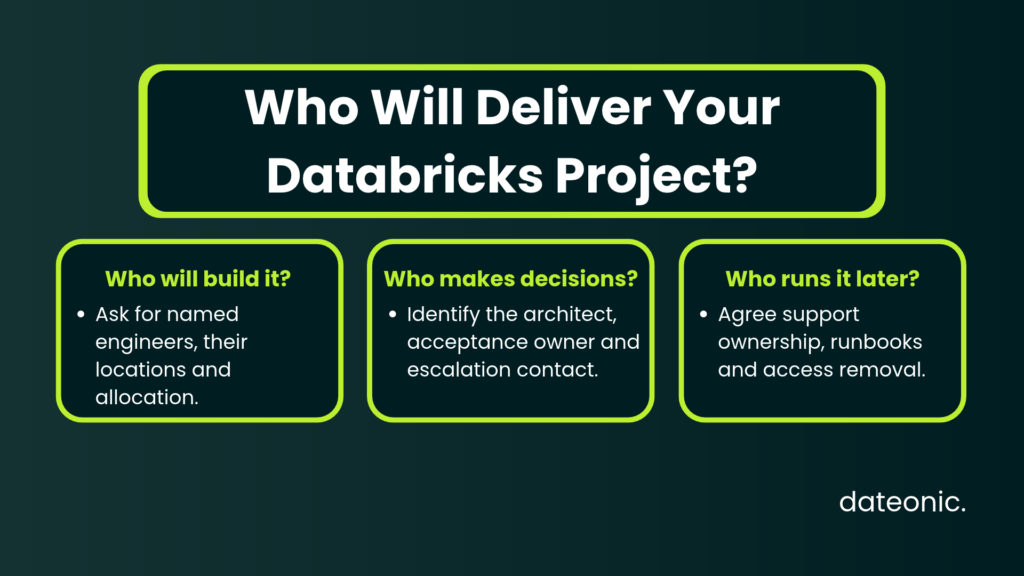
Confirm who will deliver the project, how you will work together and who will operate the result. Give shortlisted firms the same requirements so their proposals are comparable.
| Requirement | Evidence to request |
|---|---|
| Assigned team | Named architect and engineers, their working locations, allocation and relevant Databricks responsibilities |
| Working language | Languages available for architecture reviews, source-system interviews, documentation and business acceptance |
| Collaboration in Poland | Workshop location, agreed working hours, travel assumptions and escalation contacts |
| Commercial arrangement | Contracting entity, billing currency, acceptance milestones, subcontractors and separately priced support |
| Platform access | Countries from which engineers and support staff will access the environment, approved access paths and access removal |
| Internal ownership | Repositories, infrastructure definitions, deployment process, runbooks and the team accountable after handover |
Do not infer data residency from a consultancy’s address. Ask the proposed architect to document the cloud, workspace and storage regions, required services, integrations and operational access.
Likewise, request Polish-language workshops explicitly if business stakeholders need them; a Polish office alone does not establish the language of the assigned team.
If the geographic requirement is wider than Poland, use the separate European Databricks consultancy comparison. For a broader supplier set including global systems integrators, see the global consulting companies shortlist.
Which provider approach fits your starting point?
Use your starting point to choose which firms to approach. Several may fit the same project; the proposed team and scope should determine the final choice.
- A defined platform build or migration with internal handover: examine Dateonic’s implementation scope and its delivery artifacts.
- Implementation alongside reusable platforms and training: examine Xebia’s accelerators, customization model and enablement.
- Databricks within a wider enterprise change program: examine Accenture’s integration responsibilities and Polish workstream ownership.
- Data engineering connected to software products and ML: examine STX Next’s team composition and system boundaries.
- An existing estate with compute inefficiency and migration dependencies: examine Addepto’s stabilization and modernization sequence.
- Enterprise data modernization tied to supply-chain or commercial analytics: examine Lingaro’s Databricks offering and industry solutions.
What should shortlisted firms answer before you choose?
Ask each provider to walk through one representative workload: the same source systems, current failure modes, expected outputs and operating constraints. Five questions make the discussion comparable:
- Which proposed engineers work in Poland, and who can approve architecture changes?
- What implementation evidence can they show for a comparable cloud and workload, and what did that team actually deliver?
- What must pass before acceptance: output reconciliation, access-control checks, deployment recovery and operational handover?
- Which platform consumption, licenses, travel and support charges sit outside the services fee?
- What will your team own and operate when the engagement ends?
Use the 10-point Databricks partner selection checklist for the detailed interviews and evaluation scorecard. The Poland shortlist establishes who to investigate; the next step is to test the proposed team and scope.
Planning a Databricks implementation, migration or platform modernization? Dateonic can help turn an approved design or POC into a production platform, with Terraform infrastructure, data pipelines, Unity Catalog governance, CI/CD and handover.
Discuss your Databricks project with Dateonic: share your current architecture, first workload and main delivery constraint so the team can help define the scope, priorities and ownership.