
To choose a Databricks implementation partner, compare the proposed delivery team, relevant production experience and written commitments against the same project brief.
Verify credentials, inspect the evidence behind case studies, and agree how the work will be accepted and handed over before signing.
A polished proposal can describe an impressive architecture while leaving the delivery team, testing scope and support responsibilities unclear. Those gaps are easier to resolve during selection than after work has started.
This 10-point checklist helps CTOs, Heads of Data and technical procurement teams evaluate consulting and implementation providers, with questions to use in interviews and a scorecard for comparing their answers.
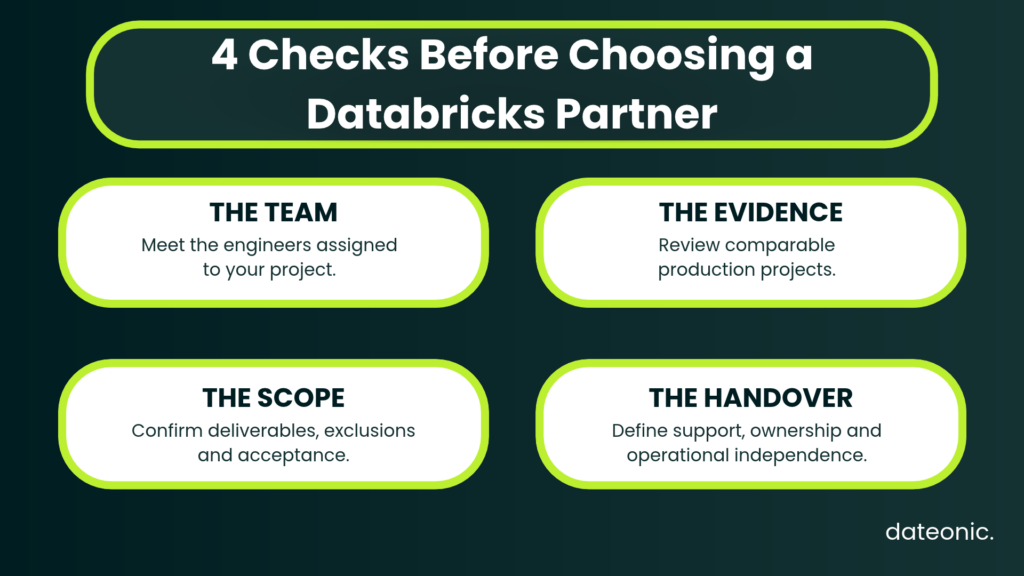
Give shortlisted partners the same project brief
Start with a concise brief that every provider receives. Include:
- The outcome: which business workload or capability must become usable, and who accepts it.
- The starting point: cloud provider, existing Databricks environment, source systems, integrations and reusable assets.
- The difficult conditions: peak volumes, reporting deadlines, sensitive data, legacy dependencies and recovery expectations.
- The delivery boundary: what the vendor owns, what your team supplies and what is explicitly outside scope.
- The constraints: budget range, procurement requirements, access approvals and any fixed business dates.
- The unknowns: assumptions that need investigation before a dependable scope or estimate can be agreed.
For example, “productionize our order-data workload on Azure, including agreed finance outputs and operational handover” gives vendors a more useful starting point than “implement Databricks.”
You do not need a finished architecture to begin selection. Where the current estate or requirements are poorly understood, request a bounded assessment and clear outputs. Dateonic’s Databricks discovery guide explains the wider assessment work.
The 10-point Databricks partner selection checklist
1. Verify the partnership claim and its relevance
Check the provider’s company identity through the official Databricks Partner Directory. If the listing or claimed status is unclear, obtain confirmation from Databricks rather than relying on a logo in the proposal.
For a services engagement, the relevant program is normally Consulting and System Integrator. Databricks also distinguishes Connected, Data and Built-On partners, whose relationships serve different purposes.
Membership in another program does not establish implementation capability.
The current Databricks Partner Program describes Bronze, Silver, Gold and Platinum tiers. The 2026 Brickbuilder Partner Network announcement introduced specialization badges for partners and Delivery Expert badges for individual practitioners.
Check the exact credential and whether it relates to your workload.
Keep tier and specialization information in perspective. They describe the company’s ecosystem relationship; they do not tell you which engineers will join your project or whether the proposed scope is deliverable.
“Which current Databricks program, tier and relevant specializations can we verify for the company delivering our contract?”
2. Meet the engineers who would do the work
A firm’s total certification count says little about the people allocated to your engagement. Request the proposed team, their responsibilities, availability and relevant credentials. Clarify which roles are confirmed and which remain subject to staffing.
Databricks’ Data Engineer Professional certification assesses advanced data engineering, including Python and SQL, governance, monitoring and deployment. Certifications are useful evidence of assessed knowledge. Production experience still needs a separate discussion.
Arrange a technical conversation with the proposed architect and engineers. Use a scenario from your brief: a late source feed, a reporting deadline, a difficult integration or an access-control requirement.
Have them explain the trade-offs, failure paths and information they would need before choosing a design.
Look for depth in the skills your scope requires: PySpark and SQL, cloud identity and networking, infrastructure as code, platform engineering, and production workload design. A strong answer acknowledges constraints and explains decisions clearly.
“Who will own architecture, engineering and release work, and what comparable production responsibility has each person held?”
3. Look for projects with comparable difficulty
An impressive client logo may hide a small contribution. Establish what the consultancy actually delivered, which engineers were involved and what remained the client’s responsibility.
Compare the project conditions with yours: cloud environment, workload type, integration complexity, sensitive data, operating requirements and downstream consumers. Industry experience matters when it brings relevant domain knowledge, reporting rules or controls.
A familiar sector alone is a weak comparison.
For a claimed improvement, request the baseline, measurement period, workload conditions and attribution. A faster query after changing both code and compute is not enough to establish an efficiency gain. The comparison needs to show what changed and what it cost.
Dateonic’s published maritime IoT case study illustrates the kind of detail worth examining: intermittent connectivity, late and duplicate sensor data, normalization and reproducible environments.
It is a provider-published account; a reference conversation would help corroborate the delivery claims.
“Which project best matches our difficult conditions, what did your team deliver, and what evidence can we review?”
4. Turn service labels into contractual deliverables
Start with this question: “What exactly will we receive, how will each deliverable be accepted, and which work is assumed to be ours?”
“End-to-end implementation” leaves too much open. The proposal needs to identify the deliverables, dependencies, exclusions and acceptance owner for each relevant workstream.
Review whether the agreed scope covers platform and cloud configuration, pipelines, integrations, governance, security, testing, production deployment, documentation and knowledge transfer. The vendor need not own every activity, but the division of responsibility must be explicit.
Watch for phrases such as “client provides test data,” “security configuration excluded” or “deployment support included.” Each can represent substantial client effort. Clarify what must be supplied, by whom and by when, and what happens if it is unavailable.
For an order pipeline, that means identifying its source, historical coverage, transformation rules, destination, consumers and acceptance evidence. With those details written down, both parties can judge whether the pipeline is complete.
Use the technical implementation checklist to identify relevant delivery areas, then assign them in the proposal. It is a scope cross-check, not a requirement to buy every possible service.
5. Assess governance and security through concrete decisions
“We use Unity Catalog” is a starting point. It does not explain data ownership, privileged access, deployment identities or the separation of environments.
The official Unity Catalog overview describes access control, lineage and auditing capabilities. Have the provider explain how its design would apply these capabilities within your cloud, identity and security standards.
Request a sanitized design or control example showing how users and service principals receive access, how sensitive assets are protected and how activity can be reviewed.
Include a denied-access scenario in the discussion, not only a demonstration that an authorized user can query a table.
Your security and compliance owners need to define the requirements and accept the evidence. Put the approval question directly to the vendor: “How will you demonstrate that our required controls work, and who approves the design and the test evidence?”
The proposal should identify what the vendor implements, what Databricks or the cloud provider supplies, and which approvals remain with your organization. Platform features alone do not establish regulatory compliance.
For technical background, see the Unity Catalog governance guide.
6. Require a credible plan for production acceptance
A demo can show a pipeline completing on sample data. Production acceptance also needs to establish whether the outputs are correct and the workload meets its operating requirements.
Look for a plan covering correct outputs, representative performance, relevant failure and recovery scenarios, deployment, monitoring and business acceptance. Establish how results and unresolved defects will be recorded, and who can authorize go-live.
The engineering approach should fit your standards. Request an example of source control, code review, automated checks and promotion between environments.
Databricks’ operational-excellence guidance supports repeatable infrastructure and automated delivery practices; the supplier still needs to show how it will apply them to your scope.
Discuss a failure in detail. If a job stops after partially writing output, what is the proposed recovery path and how will correctness be checked after retry? Code rollback and recovery of data or processing state may require different procedures.
For migration engagements, use the migration testing strategy to review whether the proposal includes appropriate validation coverage.
“What evidence must exist before go-live, and who can withhold acceptance if it is missing?”
7. Agree ownership and how decisions get made
Identify the vendor’s accountable technical lead, the client sponsor, the business acceptance owner and the operational owner. Confirm which people can approve scope changes, architectural decisions and production releases.
Communication quality becomes easier to judge when you discuss a real dependency. Suppose access to a source system is delayed. “Who owns the escalation, who can resolve it, and how does the delay affect delivery?”
The answer should name responsibilities on both sides.
Agree the reporting rhythm, escalation path, decision record and change-control process. Confirm time-zone overlap, subcontractor involvement, staff replacement rules and how the provider preserves project knowledge when someone leaves.
8. Compare proposals on equivalent scope
Before comparing prices, reconcile what each quote buys. One supplier may include deployment automation, validation and handover; another may assume your internal team supplies them.
“Which scope differences explain the price, and what circumstances would change the amount we pay?” is a useful opening for the commercial review.
Separate professional services from Databricks and cloud consumption, client effort and optional post-launch support. Then review exclusions, estimate assumptions, payment milestones and the process for approving additional work.
A fixed price needs a defined boundary; time-and-materials needs visibility into progress and remaining effort.
Clarify who bears the cost of vendor defects, changes in requirements and unresolved discovery assumptions. These situations need distinct treatment in the change-request terms.
The Databricks implementation cost guide covers the wider budget drivers. During partner selection, the immediate task is to make the competing offers comparable.
9. Use references to test the claims that matter
Speak with a client whose engagement resembles yours, where permission allows. A published testimonial is useful context; a reference conversation lets you investigate the team’s actual contribution, delivery behavior and handover.
Useful questions include:
- “Did the people introduced during selection remain involved in delivery?”
- “Where did responsibilities or exclusions become unclear, and how was that resolved?”
- “Could your team operate and modify the delivered system after handover?”
- “If you hired the firm again, what would you put in the contract earlier?”
A confidential engagement need not be dismissed. Request permitted alternatives such as a sanitized design, acceptance artifacts or a reference arranged under appropriate confidentiality terms. Record what those alternatives substantiate and what remains unconfirmed.
10. Define support and handover before signing
Agree what happens immediately after launch and when responsibility formally transfers. Distinguish stabilization and defect remediation from an ongoing support service and future enhancement work.
For support, specify service hours, incident severity, response expectations, escalation and exclusions. A response commitment is different from a restoration target. Confirm how vendor support interacts with your internal operations team and with Databricks or cloud-provider support.
Handover needs usable repositories, deployment configuration, infrastructure definitions, architecture documentation, runbooks and knowledge transfer. Establish ownership and usage rights for custom code and vendor accelerators, including any licensing or exit restrictions.
Test operational independence through an agreed handover exercise: your team deploys an approved change or diagnoses a controlled failure using the supplied documentation. Any gaps become concrete remediation items.
“What will our team be able to run, change and recover independently when the engagement ends?”
Recognize weak evidence before it reaches the scorecard
The examples below illustrate evidence quality; they are not claims about particular providers.
| Topic | Weak evidence | Stronger evidence |
|---|---|---|
| Team expertise | A company-wide certification total | Named delivery roles, current credentials, relevant experience and a technical interview |
| Claimed results | An improvement percentage without context | Baseline, measurement conditions, the vendor’s contribution and permitted client corroboration |
| Scope | “Full implementation included” | Deliverables, exclusions, dependencies, acceptance evidence and named owners |
| Production quality | A demo or a successful notebook run | Representative validation results, controlled release evidence and exercised recovery procedures |
| Support | “Support after go-live” | Agreed coverage, incident handling, responsibilities, stabilization boundary and usable handover artifacts |
Treat a refusal to clarify staffing, material scope exclusions, acceptance conditions or ownership rights as a reason to pause selection. Confidentiality can limit what a provider shares, but it should still be possible to agree a credible way to assess capability.
Use a weighted partner-evaluation scorecard
This is an illustrative editorial framework, not a Databricks standard or an industry benchmark. Adjust the weights to your project before reviewing proposals, and apply the same version to every shortlisted vendor.
| Evaluation area | Illustrative weight |
|---|---|
| Verified partnership claim and relevant credentials | 5% |
| Assigned team’s engineering and cloud expertise | 20% |
| Comparable production project experience | 15% |
| Scope, deliverables and acceptance clarity | 10% |
| Governance and security capability | 10% |
| Production readiness and quality assurance | 15% |
| Delivery ownership and collaboration | 10% |
| Commercial transparency | 5% |
| References and corroborating evidence | 5% |
| Support, handover and operational independence | 5% |
| Total | 100% |
Score each area from 0 to 5: 0 means no usable evidence was supplied; 1 means unsupported assertions; 2 means partial evidence; 3 means credible evidence addressing the requirement; 4 means strong, detailed evidence; and 5 means strong evidence corroborated through an appropriate additional check.
Calculate each contribution as weight × score ÷ 5. A score of 4 in the 20% engineering category contributes 16 points to a total out of 100. Keep the evidence, reviewer and unresolved questions beside every score.
Missing evidence should remain visible rather than becoming an optimistic assumption.
Before using the total, check non-negotiable requirements separately: required security controls, available delivery capacity, acceptable ownership rights and agreed production acceptance. If official partnership is a procurement requirement, verify it as a gate as well.
A high aggregate score cannot compensate for a failed mandatory requirement.
Make the final comparison concrete
Send the same brief and evidence requests to each shortlist member. Meet the proposed delivery team, resolve material differences in scope, and complete reference checks before final scoring. For a formal RFP, use a consistent response structure so assumptions are easy to compare.
If an important claim remains uncertain, agree a bounded assessment or paid validation engagement before committing to the full build. Specify its question, outputs, price and decision point, along with access and ownership terms.
Avoid turning it into an open-ended implementation commitment.
Make the award decision on the final proposal and agreed terms. Record any remaining conditions and their owners. The contract should reflect the team, evidence and responsibilities on which the decision was based.
Discuss your implementation scope with Dateonic
If you are evaluating providers for a new platform, an existing workload or a PoC that needs production engineering, explore Dateonic’s Databricks implementation services.
Bring your project brief, current environment and unresolved questions. Use the conversation to clarify the proposed delivery scope, responsibilities and acceptance evidence before deciding whether to proceed.