
Databricks implementation cost is the cost of getting an agreed platform or workload scope into production. It pays for architecture, platform engineering, workload development, migration, integrations, governance, testing, release work, documentation and handover.
It is separate from the cost of operating Databricks after launch.
A useful planning model is:
Implementation scope × complexity × delivery effort × team mix, adjusted for uncertainty
This is not a Databricks pricing formula. It is a way to expose the assumptions behind an estimate.
A credible budget cannot be derived from data volume, user count or expected DBU consumption alone. Two companies can plan for similar platform usage while requiring very different amounts of engineering work to reach production.
If you need to forecast DBUs, cloud compute, storage or network consumption, use Dateonic’s Databricks Pricing guide. This article deals with the delivery project.
Databricks implementation cost vs platform cost
“Databricks cost” often combines several budgets that behave differently. Separate them before evaluating an estimate.
| Cost category | What it pays for | One-time or recurring? | Where it belongs |
|---|---|---|---|
| Implementation services | Architecture, setup, engineering, testing, deployment and handover | Usually one-time or phased | This article |
| Internal client effort | Decisions, system knowledge, access, security approval, validation and operational ownership | Concentrated during delivery | This article |
| Migration | Data and code movement, remediation, reconciliation and cutover | Usually one-time | A workstream within this article |
| Databricks consumption | Usage of Databricks products and compute | Usage-based and recurring; also incurred during delivery | Databricks Pricing |
| Cloud infrastructure | VMs, storage, networking and related cloud services where applicable | Recurring; some spend begins during delivery | Databricks Pricing and the relevant cloud calculator |
| Post-launch support | Operations, incident support, further optimization and workload changes | Optional or recurring | Separate support scope |
Databricks confirms that its platform pricing is based on compute usage, with storage, networking and related cloud costs depending on the selected services and cloud provider.
That model does not tell you how much engineering is required to design and implement the environment. See official Databricks pricing.
A project budget should show both categories without merging them into one unexplained total.
What are you paying an implementation team to deliver?
An implementation estimate is easier to assess when divided into deliverable-based workstreams.
Architecture and production design
An approved concept still needs decisions about accounts, workspaces, environments, storage, compute, networking, identity, deployment and ownership.
The effort depends on how many decisions are already supported by company standards. Reusing an approved landing zone and network pattern is different from designing a new production architecture that must pass several review bodies.
Platform and environment engineering
Creating a workspace is a small task. Creating reproducible development, test and production environments can also require cloud resources, identity integration, private connectivity, policies, service principals, secrets and deployment automation.
Databricks recommends isolating software-development lifecycle environments where their settings, networks or controls differ. Each required environment introduces configuration, deployment and validation work. See Databricks operational-excellence guidance.
Infrastructure as code also has a delivery cost. The Databricks Terraform provider can manage workspaces and associated cloud infrastructure, but the modules, variables, state, review process and deployment permissions still have to be designed and tested.
Workload engineering
This is the work that turns source data and business logic into production pipelines, tables, reports, models or applications.
The important sizing unit is not simply a terabyte. It is a production workload with:
- upstream inputs;
- transformation logic;
- dependencies;
- orchestration;
- consumers;
- service expectations;
- recovery behavior;
- acceptance evidence.
A small number of highly coupled workloads can require more effort than a larger collection of independent, well-documented pipelines.
Security and governance implementation
Unity Catalog provides centralized access control, lineage, auditing and data discovery, but those capabilities still need an operating model. See the Unity Catalog overview.
Implementation may include identity provisioning, groups, service principals, catalog design, ownership, privileges, storage credentials, external locations, masking, row filters and audit integration.
The budget grows when the project must also resolve unclear data ownership or translate a legacy permission model.
CI/CD and release engineering
Production delivery often includes source control, validation, environment-specific configuration, deployment identities and promotion rules.
Databricks positions Declarative Automation Bundles as a way to apply source control, code review, testing and CI/CD practices to data and AI projects.
Implementing those practices requires more work than deploying notebooks manually, but it also changes what the client receives at handover. See Declarative Automation Bundles.
Testing and acceptance
Testing can be a modest task or a major workstream. The difference is the definition of done.
Compare these two acceptance conditions:
The pipeline completes without an error.
The pipeline produces reconciled outputs from representative data, meets its processing deadline, passes access-control tests and can be deployed and recovered through the approved release process.
Those are different deliverables.
Databricks recommends performance testing with production data or data reflecting production characteristics such as volume, file layout and skew.
A proposal that includes realistic validation must budget for test data, environments, execution, analysis and remediation. See Databricks performance-efficiency guidance.
Cutover, stabilization and handover
Going live may require release coordination, parallel operation, rollback planning, early-run monitoring, defect resolution, runbooks and knowledge transfer.
If a quote stops at “deployed to production,” ask who owns the first failed run, who proves output parity and when operational responsibility formally passes to the client.
The main drivers of Databricks implementation cost
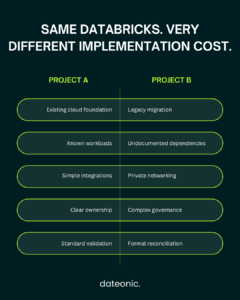
1. The starting point
A project may begin with:
- a greenfield cloud environment;
- an approved cloud foundation;
- an existing Databricks account;
- a working proof of concept;
- a legacy platform that must be retired;
- an existing Databricks estate with inconsistent patterns.
Greenfield does not automatically mean expensive, and an existing platform does not automatically make delivery cheaper.
A clean foundation with agreed standards may be easier to implement than a partially built environment containing manual resources, undocumented permissions and code never designed for production.
A POC can shorten implementation when its logic is reusable. It can add remediation work when “productionization” means redesigning identity, deployments, monitoring, tests and operational ownership around experimental code.
2. The number and complexity of production workloads
Count workloads, then weight them by complexity.
Relevant characteristics include:
- number and type of sources;
- transformation depth;
- batch, streaming or interactive execution;
- orchestration dependencies;
- data-quality behavior;
- BI, application and ML consumers;
- latency and availability requirements;
- failure recovery;
- business criticality.
Twenty isolated ingestion pipelines may be cheaper to deliver than five workloads tied to stored procedures, event streams, business reports and a tightly controlled release window.
Raw data volume matters when it changes transfer, backfill, testing or performance work. It is not a sufficient proxy for implementation effort.
3. Migration and remediation
Migration adds more than copying data.
The delivery team may need to inventory the estate, analyze dependencies, convert code, redesign unsupported patterns, backfill history, reconcile results, run both platforms and coordinate decommissioning.
Databricks’ migration approach uses profilers and analyzers to understand actual usage and code complexity before refining effort and cost. Its guidance then separates assessment, strategy, a production pilot and later migration phases. See the Databricks migration strategy.
Automation can reduce repetitive conversion work, but it does not eliminate scope. Lakebridge covers assessment, conversion, validation and reconciliation because migration completion requires more than translated SQL. See Databricks Lakebridge.
For a detailed treatment of elapsed duration, see How Long Does a Databricks Migration Take?
4. Platform and environment requirements
A basic environment and an enterprise production foundation are not equivalent scopes.
Budget changes may come from:
- separate development, test and production environments;
- multiple business-unit or regional workspaces;
- reusable Terraform modules;
- private network paths;
- on-premises connectivity;
- identity-provider integration;
- secrets and key management;
- service principals;
- compute and workspace policies;
- CI/CD;
- monitoring and alerting;
- disaster-recovery requirements.
Not every project needs every component. The estimate should state which patterns are required and who implements them.
5. Security, governance and compliance
“Implement Unity Catalog” is too broad to price.
A bounded governance scope might cover one metastore, a defined catalog structure, agreed groups and basic privileges.
A larger scope may include domain ownership, environment isolation, automated identity lifecycle, sensitive-data classification, row- or column-level controls, lineage requirements, audit evidence and integration with security operations.
Regulated requirements also introduce review and evidence work. The engineering team may have to demonstrate that controls behave as designed, respond to findings and document the result.
The cost comes from the controls and evidence required, not governance as an abstract label.
6. Testing and the definition of done
A narrow technical validation may require unit, integration and smoke tests. A production migration may also require:
- source-to-target reconciliation;
- business UAT;
- performance and SLA testing;
- access-control testing;
- failure and recovery tests;
- disaster-recovery validation;
- a parallel run;
- formal production acceptance.
The estimate should name the required evidence and the person authorized to accept it.
Testing responsibility matters when comparing quotes. One supplier may include reconciliation and UAT support while another assumes the client will perform them.
7. Team composition and seniority
A project budget depends on both total effort and who performs it.
Architecture leadership may be concentrated around design decisions and technical reviews. Data engineers may carry most workload development.
Platform engineers may own networking and infrastructure automation. Governance or security specialists may join only for defined controls. ML engineers are relevant only when ML or AI workloads are in scope.
A senior specialist usually has a higher rate than a generalist. The comparison should consider allocation as well as rate:
- Is a senior architect assigned where architectural judgment is needed?
- Is expensive specialist time being used for routine implementation?
- Does the team cover the work without adding unnecessary roles?
- Who remains accountable when work crosses platform, data and security boundaries?
For detailed responsibilities, see Roles for Databricks Implementation.
8. Client-side contribution
External effort depends partly on what the client provides.
A client team may retain responsibility for cloud infrastructure, source access, business logic, testing or documentation. That can reduce the supplier’s scope, provided the internal owners are available and capable of delivering their part.
The opposite also happens. Engineers spend time reconstructing undocumented logic, waiting for access or preparing evidence the client was expected to provide.
Separate these effects:
- Engineering effort is the productive work required to deliver the scope.
- Calendar duration also includes waiting, sequencing, approval and availability constraints.
A delayed security decision can extend the schedule without creating an equal amount of useful engineering output. It can still increase cost if the supplier must retain people, replan work or revisit completed decisions.
9. Delivery and commercial model
The contract determines how uncertainty is allocated.
| Model | Best suited to | Main buyer exposure | Main supplier exposure |
|---|---|---|---|
| Fixed scope and fixed price | Stable deliverables and acceptance criteria | Changes and exclusions | More effort than estimated within the agreed scope |
| Time and materials | Evolving or technically uncertain work | More effort means more cost | Lower utilization or a shortened engagement |
| Capped T&M | Work requiring flexibility within a financial ceiling | Scope may need reprioritization near the cap | Some overrun or delivery-management risk |
| Phased implementation | Large scope that can be divided into decision points | Later phases remain uncommitted | No guarantee that the full programme proceeds |
| Discovery followed by implementation | Scope or dependencies are not yet reliable | Separate upfront assessment cost | Less hidden uncertainty in the implementation quote |
Fixed price does not remove uncertainty. It changes how that uncertainty appears: contingency, assumptions, exclusions, change requests or supplier risk.
10. Uncertainty and contingency
An estimate becomes less reliable when the team cannot inspect what it is expected to change.
Common sources of uncertainty include:
- incomplete workload inventories;
- undocumented stored procedures;
- unknown downstream consumers;
- unavailable source-system owners;
- untested connectors;
- unclear security requirements;
- missing test data;
- acceptance criteria that have not been agreed.
A useful discovery phase turns some unknowns into evidence and leaves the rest visible. Dateonic’s Databricks Discovery Phase guide explains what should be assessed before implementation.
Contingency should not be a hidden percentage added to an unexplained total. Tie it to named uncertainties, explain how they could affect the work and define when the allowance can be released or re-estimated.
A practical model for estimating the budget
Start with workstreams, not a single project total.
For each workstream, record:
- the deliverable;
- the unit being sized;
- its complexity;
- the required capabilities;
- estimated effort by role;
- dependencies and client responsibilities;
- estimate confidence.
| Workstream | Example scope unit | Main complexity driver | Required capability | Estimate confidence |
|---|---|---|---|---|
| Architecture | Approved production design | Number of unresolved design and review decisions | Databricks and cloud architecture | High only after requirements are agreed |
| Platform foundation | Account, workspace or environment | Network, identity and isolation requirements | Platform and cloud engineering | Depends on reusable client patterns |
| Infrastructure as code | Module or deployable environment | Existing standards, resource coverage and approval flow | Terraform and DevOps | High after target design is fixed |
| Governance | Domain, catalog or access pattern | Ownership, sensitive data and policy complexity | Unity Catalog and security | Low when ownership is unresolved |
| Integration | Source or consumer interface | Authentication, change behavior and connector maturity | Data and integration engineering | Low until access is tested |
| Workload delivery | Production pipeline, job, report or model | Logic, coupling, SLA and recovery behavior | Relevant workload engineering | Improves after representative inspection |
| Migration | Workload family or migration wave | Code conversion, dependencies and remediation | Migration and data engineering | Improves after profiling and analysis |
| Testing | Acceptance pack per workload or release | Reconciliation depth and non-functional requirements | QA, engineering and business validation | High when definition of done is explicit |
| Release and handover | Production release or operating package | Cutover risk and client operating maturity | DevOps, delivery and enablement | Depends on ownership readiness |
The commercial calculation can then be expressed as:
External delivery budget = effort by role × agreed rates + explicit delivery expenses + risk allowance
Calculate internal effort separately. Forecast platform consumption separately.
This produces three visible views:
- what the partner will charge;
- what the client must contribute;
- what the implemented platform is expected to cost to operate.
That is more useful than one “Databricks budget” containing all three.
Use confidence, not false precision
A workstream estimate should carry a confidence rating:
- High confidence: scope inspected, dependencies confirmed and acceptance agreed.
- Medium confidence: scope understood, but some technical or organizational assumptions remain.
- Low confidence: the work is based mainly on counts, descriptions or untested access.
Low confidence does not mean the work cannot proceed. It means the commercial model, contingency or phase boundary should reflect what remains unknown.
How the cost structure changes between project types
The scenarios below describe delivery shapes, not price bands.
| Project shape | Starting position | Where delivery effort concentrates | Main estimate risk |
|---|---|---|---|
| Focused implementation | Existing cloud foundation and a bounded set of known workloads | Workload engineering, production deployment, testing and handover | Hidden production requirements behind a working POC |
| Multi-workload platform implementation | Several sources and production workloads requiring shared standards | Platform foundation, integrations, governance, CI/CD and workload delivery | Cross-team dependencies and inconsistent requirements |
| Complex migration or modernization | Legacy platform with code, consumers and operating processes that must be replaced | Assessment, remediation, reconciliation, parallel running and cutover | Undocumented dependencies and unclear retirement criteria |
Dateonic’s case studies show why the labels alone are insufficient. A maritime sensor platform required late and duplicate event handling, signal normalization, lineage and reproducible environments.
A SQL Server migration included stored-procedure remediation, dependency mapping, parallel running and business reconciliation. A banking governance implementation concentrated on domain ownership, tenant isolation, masking, identity groups and reusable Terraform modules.
These are examples of different delivery shapes, not evidence of a typical Databricks implementation price.
What should a Databricks implementation quote contain?
A buyer should be able to reconstruct the proposed scope from the quote or its attached Statement of Work.
| Area | What should be explicit | Common ambiguity |
|---|---|---|
| Production outcome | What will be live and usable at acceptance | “Platform implementation” with no finish line |
| Workloads | Included pipelines, jobs, reports, models and applications | Object counts without complexity |
| Environments | Development, test, staging, production and DR scope | Workspace creation mistaken for full environment delivery |
| Sources and integrations | Systems, interfaces, authentication and ownership | Connector assumed to work without validation |
| Migration | Data, code, history, orchestration and decommissioning responsibility | “Migration included” meaning data copy only |
| Governance and security | Identity, catalogs, privileges, masking, lineage and evidence | Unity Catalog enabled but not designed |
| Infrastructure | Cloud resources, networking, Terraform and deployment ownership | Client-owned work not reflected in dependencies |
| Testing | Test types, data, tooling, remediation and acceptance authority | Supplier tests code; client expected to prove parity |
| Release | Deployment process, cutover, rollback and stabilization | Production deployment included, cutover support excluded |
| Handover | Code, modules, runbooks, documentation and training | A documentation line with no defined outputs |
| Client responsibilities | Decisions, access, SMEs, validation and internal engineering | Dependencies described as informal expectations |
| Commercial controls | Assumptions, exclusions, rate basis, cap and change process | Low initial total dependent on future change requests |
This is also where implementation should be distinguished from advisory work. Databricks directs custom professional-services projects toward a tailored Statement of Work rather than a universal project tariff. See Databricks Forward Deployed Engineering.
Why the cheaper quote may cover less
A lower quote can be the right choice. It may reflect reusable components, a more efficient team, narrower scope or lower rates.
It can also reflect a different finish line.
Check whether the lower estimate:
- ends at architecture or a POC;
- excludes cloud and network implementation;
- assumes the client will remediate legacy code;
- excludes data reconciliation;
- leaves UAT entirely to the business;
- treats security integration as client-owned;
- covers deployment but not production acceptance;
- omits monitoring, runbooks or training;
- assumes immediate access and decision availability;
- excludes stabilization after go-live.
The objective is not to make every quote larger. It is to compare equivalent scopes.
Normalize the proposals first. Then compare team mix, effort, rates, risk allocation and commercial terms.
How to build a defensible Databricks implementation budget
Before approving a budget:
- Define the first production outcome and its acceptance criteria.
- Split the scope into inspectable workstreams.
- Size production workloads by complexity and coupling, not volume alone.
- Assign partner and client responsibilities.
- Estimate effort by capability rather than applying one blended team rate blindly.
- Record assumptions and dependencies beside the affected workstream.
- Give each estimate a confidence level.
- Separate implementation fees, internal effort and recurring platform spend.
- Compare vendor proposals against a normalized scope.
- Re-estimate when discovery or a production pilot replaces assumptions with evidence.
A useful estimate makes disagreement possible. Engineering, finance, security and the supplier should be able to see which assumption changes the total and why.
Final takeaway
Databricks implementation cost is primarily a delivery-scope and engineering-effort problem.
Platform size matters only where it changes the work: more complex workloads, larger backfills, additional environments, stricter testing or different operational requirements. It does not produce a meaningful implementation price on its own.
The most defensible budget is built from named deliverables, complexity, role-based effort, client responsibilities and visible uncertainty.
It should also state what the team will have at the end: a demonstration, a deployed workload or a production system that has passed agreed acceptance and can be operated by its owner.
If you need to turn an approved Databricks scope or existing POC into a production platform, explore Dateonic’s Databricks implementation services.