
A bounded Databricks migration can fit within a quarter. A mixed enterprise platform usually takes several months. A legacy modernisation involving tightly coupled workloads, procedural code, streaming, governance redesign and a long parallel run may span multiple quarters.
Those are planning shapes, not universal benchmarks. Current Databricks migration guidance does not define one standard duration; it recommends estimating from assessed workloads and code complexity.
The meaningful unit is the production workload: the pipelines, dependencies, consumers, controls and acceptance evidence that must work together before the source platform can be retired.
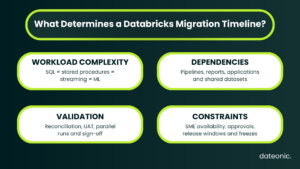
The most defensible estimate follows this chain:
Scope → workload complexity → dependencies → validation requirements → organisational constraints → calendar duration
That is also why a reliable answer cannot come from data volume alone.
Illustrative planning ranges
The ranges below are scenario-based planning bands, not Databricks-published averages, Dateonic guarantees or industry benchmarks. They are useful for an initial conversation and should be replaced by an inventory-based estimate after assessment and a representative pilot.
| Migration profile | Illustrative calendar range | Typical characteristics | What usually controls the end date |
|---|---|---|---|
| Bounded analytics migration | 8–14 weeks | One source platform, documented batch pipelines, straightforward SQL, limited BI dependencies, established cloud and security patterns | Environment readiness, conversion of the critical workloads, reconciliation and business sign-off |
| Mixed multi-workload migration | 4–9 months | Several domains or sources, batch plus BI and some streaming or ML, governance changes, multiple environments and a phased cutover | Dependency discovery, complex workload conversion, UAT availability and wave sequencing |
| Complex legacy modernisation | 9–18+ months | Multiple platforms, procedural or proprietary code, weak documentation, tightly coupled consumers, strict regulatory evidence and extended coexistence | Undocumented dependencies, architecture decisions, high-risk rewrites, parallel running and decommission approval |
The figures refer to the selected scope reaching its agreed definition of done, not the first successful pipeline or proof of concept.
What does “migration complete” mean?
Two estimates can differ by months while both appear reasonable because they use different finish lines. Before discussing dates, define whether completion means:
- a production pilot is live;
- the first business domain has moved;
- every in-scope workload is running on Databricks;
- downstream reports and ML consumers have switched over;
- the source and target have completed the required parallel run;
- the legacy platform has been decommissioned.
The last definition is normally the longest. It includes technical delivery, business acceptance and the operational evidence needed to switch off the old estate.
The factors that change a Databricks migration timeline
Databricks’ migration guidance recommends using profilers and code-complexity analysers to identify workload usage, DDL, DML, stored procedures, ETL jobs and complexity before estimating cost and time.
Lakebridge follows the same principle: assess the landscape and orchestration, analyse code, convert supported workloads and reconcile source and target data.
| Migration characteristic | Lower-complexity case | Higher-complexity case | Timeline impact |
|---|---|---|---|
| Production workloads | Small, deliberately bounded scope | Many domains with different owners and release cadences | High |
| Code | Standard SQL and current Spark patterns | Stored procedures, custom UDFs, proprietary ETL or old Spark APIs | High |
| Dependencies | Documented upstream and downstream links | Shared tables, hidden jobs, spreadsheet extracts and unknown consumers | High |
| Orchestration | Independent scheduled jobs | Long DAGs, event-driven flows and cross-platform dependencies | High |
| Streaming | None or tolerant of replay | Stateful, low-latency or exactly-once-sensitive workloads | High |
| BI and reporting | Few governed reports | Large semantic/report estate with many business owners | High |
| ML and MLOps | Batch scoring with reproducible code | Feature dependencies, model registry changes, online serving and approval controls | High |
| Governance | Target model already agreed | Roles, ownership, masking and domain boundaries must be redesigned | High |
| Security and networking | Approved landing zone and reusable patterns | Private connectivity, firewall changes and several review bodies | Medium to high |
| Historical data | Accessible, stable and easy to replay | Large backfill, limited transfer windows or continuously changing source | Medium to high |
| Test automation | Existing data-quality and regression suites | Manual reconciliation and undocumented acceptance rules | High |
| Environments | Existing dev, test and production pattern | Several regions, workspaces or regulated environments | Medium |
| Internal capacity | Dedicated SMEs and decision-makers | Shared engineers, scarce source experts and slow approvals | High |
| Release constraints | Flexible cutover windows | Seasonal freeze, quarterly release train or third-party dependency | High for elapsed time |
Object count should be weighted by complexity and coupling. One hundred independent SQL jobs may be easier to migrate than twenty pipelines that share undocumented business logic and feed critical reports.
Migration timeline by workload type
| Workload or migration type | Relative complexity | What drives duration | Can work run in parallel? | Common schedule risk |
|---|---|---|---|---|
| Straightforward SQL and BI | Low to medium | Dialect differences, semantic-layer changes, report inventory and business acceptance | Usually, by subject area | A small number of business-critical reports delays sign-off for the whole wave |
| Batch ETL pipelines | Medium | Dependency depth, restart behaviour, SLAs, data-quality rules and orchestration changes | Often, after shared foundations are ready | Teams estimate code conversion but omit integration and reconciliation |
| Stored-procedure estate | High | Procedural logic, temporary objects, dynamic SQL, side effects and undocumented business rules | Partly, if procedures can be grouped by domain | Automated conversion produces code that still requires redesign or extensive testing |
| Streaming pipelines | High | State, ordering, replay strategy, late data, schema evolution and cutover continuity | Limited around shared sources and state | The target works in test but cannot prove safe continuity under production conditions |
| ML and MLOps | Medium to high | Feature lineage, training reproducibility, registry and serving changes, model validation and approvals | Yes for some models, once data products are stable | Data migration finishes before feature and model consumers are ready |
| Hadoop or legacy Spark | Medium to high | Version gaps, HDFS assumptions, Hive dependencies, Oozie, custom libraries and non-Spark code | Often by workload family | “Spark to Spark” is treated as compatibility rather than tested behaviour |
| Snowflake or data warehouse | Medium to high | SQL dialect, stored procedures, tasks/streams, BI dependencies, performance acceptance and governance translation | Often by schema or business domain | Table conversion is mistaken for end-to-end workload completion |
| Hive Metastore to Unity Catalog | Medium to high | Table type, storage location, identities, grants, views, lineage and application changes | Yes, with controlled coexistence | Metadata moves quickly but permissions and workload references do not |
| Multi-platform enterprise estate | Very high | All of the above plus shared consumers, multiple owners and cross-platform release sequencing | Yes, but only after architecture and ownership boundaries are clear | Parallel teams create coordination overhead and converge on the same scarce SMEs |
This comparison is intentionally relative. Lakebridge’s current support matrix shows that assessment, conversion and reconciliation support differ by source.
A supported SQL dialect does not mean every orchestration pattern, custom library or report can be migrated automatically.
Unity Catalog migrations illustrate the same point. Databricks documents several paths, including UCX, the upgrade wizard, SYNC, CLONE and CTAS.
External tables may be registered without copying data, while managed-table paths may require copying and can affect table history. Duration therefore depends on storage, permissions and consuming workloads, not simply table count.
See the current Hive Metastore to Unity Catalog migration options.
Which phases consume the schedule?
Phases are useful for estimating where time goes, but they should not be presented as a universal week-by-week roadmap.
| Activity | When it stays contained | Why it expands | Typical role in the schedule |
|---|---|---|---|
| Scope and dependency assessment | Reliable metadata, current documentation and available source SMEs | Shadow workloads, obsolete assets and unclear ownership | Often determines estimate confidence; can become the first critical-path item |
| Platform, security and governance decisions | Approved landing zone and reusable organisational standards | New private networking, identity design, legal review or unresolved ownership | Can block all build work even when engineering capacity is available |
| Workload conversion and remediation | Standard patterns, supported tooling and independent domains | Proprietary logic, custom UDFs, weak tests and architectural redesign | Usually dominates engineering effort |
| Historical load and catch-up | Good bandwidth, stable source and a tested incremental strategy | Transfer constraints, source load limits and changing data during migration | May run beside code conversion, but must finish before final validation |
| Technical validation | Automated reconciliation and explicit tolerances | Poor source quality, non-deterministic outputs and manual comparisons | Commonly dominates late-stage engineering time |
| Business UAT and parallel run | Named owners, reserved time and agreed acceptance criteria | Month-end cycles, regulated evidence, unavailable SMEs and repeated exceptions | Frequently controls calendar duration rather than engineering effort |
| Cutover and decommissioning | Flexible release window and agreed rollback criteria | Change freezes, third parties, contractual dependencies and risk committees | A short task that can create a long wait |
Databricks explicitly recommends data validation, active participation from business subject-matter experts, parallel testing and data reconciliation. It also notes that executive alignment helps secure timely UAT participation and agreement on decommissioning.
That makes validation and sign-off first-class schedule items, not a small testing phase added after development. See Databricks Migration Strategy: Lessons Learned.
Engineering effort is not calendar duration
Engineering effort is the sum of the work required to assess, build, remediate, test and support the migration. Calendar duration is the elapsed time until the agreed finish line.
For example, a migration estimated at 300 engineering days will not necessarily finish in 60 working days with five engineers. Some work can be parallelised, but the project still has shared foundations, ordered dependencies, review queues and scarce decision-makers.
Adding people may also increase coordination and review overhead.
A useful planning model is:
Calendar duration = longest dependent workstream + approval and acceptance windows + contingency for unresolved risks
Estimate engineering effort separately:
Engineering effort = platform work + workload conversion + integration + validation + cutover support + remediation allowance
This distinction also improves budgeting. A blocked security approval may add little engineering effort but several weeks of elapsed time. Conversely, parallel conversion teams may increase engineering spend without moving the final date if UAT remains the bottleneck.
What usually sits on the critical path?
The critical path is the longest chain of dependent activities that controls the end date. For many migrations, it includes some combination of:
- enough dependency discovery to define the first production wave;
- target architecture, identity, network and governance decisions;
- provisioning production-capable environments;
- conversion of the most coupled or least automatable workload;
- end-to-end validation through downstream reports or applications;
- the required parallel run and business acceptance;
- an available cutover window and decommission approval.
Other work can proceed alongside this chain. Teams can inventory later domains while building the pilot, translate independent workloads in parallel and prepare historical loads while code is being remediated.
Parallelism has limits. Teams cannot finalise dependent workloads while the target data model is unresolved, and more engineers cannot compress a mandatory month-end validation cycle. The estimate should show fixed and sequential constraints explicitly.
How to create a defensible estimate
1. Define the scope in production workloads
Count end-to-end workloads, not just tables or notebooks. Each workload record should include its sources, code, orchestration, outputs, consumers, owner, SLA, security class and retirement decision.
2. Remove work that should not migrate
Identify unused jobs, duplicate tables and reports with no active owner. Databricks’ migration guidance recommends using assessment to refine scope and eliminate outdated assets before execution.
3. Classify complexity across several dimensions
For each workload, rate conversion difficulty, dependency depth, data movement, validation burden, governance change and business criticality.
4. Estimate by workload class using evidence
Use repository and platform analysis where possible. Lakebridge assessment can profile supported sources and analyse SQL, ETL and orchestration assets. Supplement it with interviews for manual controls and business-owned dependencies.
5. Calibrate with a representative production pilot
Choose an end-to-end workload that includes risks expected in later waves. An easy SQL pilot will not calibrate stored-procedure remediation, streaming continuity or regulated UAT. Databricks recommends using pilot lessons to shape later parallel sprints.
6. Convert effort into calendar time
Apply realistic team capacity, then add dependencies, review lead times, UAT windows, parallel-run requirements, freezes and third-party dates.
7. Publish a range with assumptions
A board-ready estimate should include:
- a likely range rather than one date;
- the scope and definition of done;
- staffing and parallel-work assumptions;
- the critical path;
- excluded workloads;
- the largest unresolved risks;
- the date or event that will trigger re-estimation.
Reforecast after the pilot and each wave as measured conversion rates, defects and sign-off times replace assumptions.
Three illustrative migration scenarios
Scenario A: bounded analytics migration
Planning band: 8–14 weeks. This is an illustrative range, not a delivery promise.
The scope contains one source platform, documented batch pipelines and SQL transformations, a small report estate and no stateful streaming or production ML. The cloud landing zone already exists.
Environment readiness, critical-pipeline conversion and report reconciliation control the date. Existing tests and reserved UAT time may shorten it; unmanaged BI extracts may extend it.
Estimate it workload by workload, then validate the assumptions with one representative end-to-end pipeline and report.
Scenario B: mixed enterprise data platform
Planning band: 4–9 months. This is an illustrative range, not an industry average.
The programme covers several domains and sources, batch pipelines, downstream BI and some streaming or ML. Unity Catalog, environment separation and access controls are in scope. Different business teams own acceptance.
Dependencies, governance decisions, the hardest workload class and UAT throughput dominate. Parallel domain teams help once shared decisions are stable, but not if they compete for the same experts.
Estimate by domain and workload class, then model the shared platform and sign-off path separately. The end date is not the sum of every domain’s effort; it is the longest dependency chain across them.
Scenario C: complex legacy modernisation
Planning band: 9–18+ months. This is an illustrative envelope for a phased programme, not a universal Databricks benchmark.
The estate spans a legacy warehouse, Hadoop or another cloud platform. It includes procedural code, custom UDFs, coupled orchestration, streaming, ML consumers, weak documentation and regulated data. The source must remain operational during coexistence.
Unknown dependencies, target-model decisions, high-risk rewrites, validation and decommission approval govern the date. More conversion engineers help only after shared decisions and workload boundaries are clear.
Estimate the first domain in detail, use a representative pilot to measure remediation and defect rates, and keep later waves as ranges until those observations are available. Report first-value and full-decommission dates separately.
Can you shorten the migration timeline?
Yes, but the strongest levers reduce scope uncertainty and waiting time rather than merely adding engineers.
- Limit Wave 1. Move a coherent business outcome with its full dependency chain instead of a random list of easy tables.
- Inventory before committing to a date. Early workload and dependency evidence reduces rework and exposes assets that can be retired.
- Use a representative pilot. Select enough complexity to calibrate the rest of the programme.
- Run independent workstreams in parallel. Platform, migration tooling, later-wave assessment and test automation can overlap when interfaces and ownership are clear.
- Automate selectively. Code conversion and reconciliation tools can reduce manual work where the source and construct are supported. Human review and acceptance still remain.
- Agree acceptance criteria early. Define tolerances, test evidence, business owners and sign-off authority before UAT begins.
- Resolve security and networking decisions early. An approved production pattern prevents every workload team from waiting on the same review.
- Reserve stakeholder capacity. Put source SMEs, BI owners, risk teams and cutover approvers into the plan rather than assuming they will be available later.
Compression has trade-offs. A narrower first wave delivers value earlier but does not complete the estate. More parallel teams raise cost and coordination load.
Shorter parallel running reduces the evidence available before cutover. Automated translation speeds suitable code paths but does not remove responsibility for correctness, security or performance.
Get a timeline based on your actual workloads
A useful Databricks migration estimate starts with a workload and dependency assessment, not a generic range.
Dateonic can turn your source inventory, code complexity, governance requirements, validation needs and internal capacity into a scoped delivery range with explicit assumptions and critical-path risks.
Discuss your Databricks migration scope and timeline with Dateonic.
If you need the execution sequence rather than the estimation model, see the Databricks implementation process and implementation checklist. For source-specific considerations, use the Snowflake to Databricks migration guide or Hadoop to Databricks migration guide.