
Databricks can be an excellent enterprise platform and still be the wrong investment for a particular organization.
The deciding factor is not whether Databricks can run a workload. Its current platform spans data engineering, SQL analytics, streaming, machine learning, AI and governed data assets.
The harder question is whether bringing those capabilities together creates enough value to justify migration, platform ownership, governance change and ongoing cost.
For an enterprise with fragmented batch and streaming pipelines, production ML and inconsistent governance, the case may be strong. A company that mainly needs dependable SQL reporting may gain little from the added operating model.
This framework is designed to reach one of three preliminary decisions:
- Strong fit: Databricks belongs on the shortlist and merits detailed validation.
- Conditional fit: the case depends on assumptions that need architecture assessment, benchmarking or a proof of concept.
- Weak fit: Databricks is technically possible, but likely to create more complexity than value.
A strong fit does not prove that Databricks will outperform every alternative. It means the enterprise has a credible reason to evaluate it seriously.
Start with the problem, not the platform
Databricks describes a broad platform because it genuinely supports a broad set of workloads. Lakeflow covers ingestion, transformation and orchestration. Databricks SQL provides data warehousing and BI capabilities.
The platform also supports batch and streaming processing, machine-learning development and serving, and centralized governance through Unity Catalog.
For an introduction to the platform itself, see Databricks for Beginners.
That breadth is relevant only if it addresses real enterprise friction.
A platform decision should begin with the current business workloads, service levels, control requirements and costs. “We want a lakehouse” is a proposed architecture.
“We need hourly inventory availability across stores and e-commerce, with governed inputs for forecasting and customer-facing applications” is a requirement that can be tested.
The same discipline applies to AI. “We need to be ready for AI” is not yet a workload. A production demand-forecasting system with named users, retraining requirements, governed features, monitoring and an accountable owner is.
Before evaluating Databricks, write down what must improve and how the organization will recognize that improvement. If the case still depends mainly on product language, it is not ready for a platform decision.
The executive decision matrix
Use this matrix as a discussion tool, not a scoring formula. A collection of green signals strengthens the case. A single green signal rarely settles it, while one serious disqualifier can be enough to pause the decision.
| Decision factor | Strong Databricks signal | Yellow flag: validate | Weak-fit signal |
|---|---|---|---|
| Workload portfolio | Data engineering, analytics, streaming and production AI or ML need to use shared data and controls | Two or more workload types exist, but the benefit of consolidation is unclear | Requirements are mainly straightforward reporting and scheduled SQL transformations |
| Data processing | Distributed processing, complex transformations, variable workloads or mixed data types create material constraints | Scale is growing, but the current platform has not been benchmarked or tuned | Current workloads are modest, predictable and already meet service levels economically |
| Governance | Several teams need consistent access control, lineage, audit and ownership across data and AI assets | Governance requirements are real, but ownership and policy design are immature | The buyer expects the platform to resolve missing ownership or undefined policies automatically |
| Existing estate | Databricks aligns with the cloud, lake and engineering direction, and can replace measurable fragmentation | The current warehouse works, while new AI or engineering needs may justify an additional platform | Existing systems meet requirements and few tools or processes could realistically be retired |
| Engineering model | The organization can own data engineering, platform operations, CI/CD, observability, governance and FinOps | Skills can be built or transferred, but responsibilities and support capacity are not yet agreed | There is no credible owner for production operations, governance or cost control |
| AI and ML | Production models or AI applications depend on governed enterprise data and require lifecycle management | Use cases are promising but still experimental or lack production acceptance criteria | AI is mainly a future aspiration used to justify broad modernization |
| Streaming and latency | Event processing is tied to business service levels and shares data or logic with batch workloads | “Real time” is requested, but latency, volume and business response are undefined | Daily or periodic refresh already meets the business need |
| Economics | Consolidation, productivity or new capability can be tested against migration and operating costs | Benefits depend on retiring tools or changing processes that may remain | The business case counts platform capabilities that will not be used or systems that cannot be retired |
| Architecture constraints | Cloud, identity, networking, residency and integration patterns are compatible with the intended design | Regional availability, private connectivity or service limitations need validation | Mandatory constraints conflict with the required deployment model and no acceptable design has been demonstrated |
1. Does workload breadth create real consolidation value?
Databricks becomes more compelling when multiple workload families need to operate over shared data with consistent controls.
A retailer may combine ingestion from operational systems, batch transformations, event processing, SQL analytics, forecasting models and AI applications. In that environment, fewer duplicated data copies, security models and deployment paths can be valuable.
But counting workloads is not enough. An organization can have BI, data science and streaming teams that require different service levels, technologies or release cycles. Forcing every workload onto one platform may create coupling rather than useful consolidation.
Ask what would actually become simpler:
- Which data copies, handoffs or tools would disappear?
- Which teams would work from the same governed assets and controls?
- Which systems would remain regardless of the decision?
If the answer is that every existing tool stays while Databricks becomes another layer, the consolidation case is weak. Databricks may still be justified for a specific workload, but the enterprise-platform narrative has not been proven.
2. Do scale and complexity require a distributed data platform?
“We have a lot of data” is not a useful qualification criterion. Volume matters only in relation to processing, concurrency, latency, data shape, growth, reliability and cost.
A smaller estate can justify Databricks when transformations are computationally demanding, streaming and batch logic must coexist, or ML training needs elastic processing.
A larger estate may not justify a change if a current platform handles predictable SQL workloads within acceptable service levels and cost.
Inventory representative workloads rather than relying on total storage. Capture their inputs, growth, transformation complexity, dependencies, latency, concurrency, recovery requirements and current operating cost.
Databricks uses Delta Lake as the default table format and integrates it with Spark processing for batch and streaming workloads. Delta Lake adds a transaction log, ACID transactions and scalable metadata handling to data in cloud object storage.
Those capabilities are relevant where they solve observed reliability or processing constraints. They are not evidence that an already adequate workload must move.
3. Would shared governance solve an organizational problem?
Unity Catalog can enforce access controls, track lineage, log activity and govern data and AI assets across Databricks workspaces. This is a meaningful fit signal when several teams need a common control plane and the current estate applies policies inconsistently.
The platform does not decide who owns customer data, which classification policy applies or who approves access. Buying governance technology without a governance operating model tends to digitize ambiguity.
A strong-fit organization can answer questions such as:
- Who owns the important data and approves access?
- Which policies must be central and which can be delegated?
- What lineage, audit and retention evidence is required, and who responds when controls fail?
If these questions have no owners, the answer is not necessarily “no Databricks.” It is usually “conditional fit: resolve the operating model before treating governance as a benefit.”
4. Is the current architecture a reason to move or a reason to stay?
A modern platform is not automatically better than a working one. The decision must account for the enterprise’s existing cloud contracts, data lake or warehouse, integration tools, BI estate, identity standards, network controls, technical debt and team expertise.
Databricks may fit naturally where cloud object storage is already strategic, engineering teams need scalable processing, and analytics and AI workloads would benefit from a governed lakehouse foundation.
It may also be a credible modernization path for an estate constrained by legacy Hadoop operations or fragmented processing tools.
The case is weaker when a mature warehouse delivers the required analytics economically, business users are productive, and proposed Databricks workloads would duplicate rather than replace the existing platform.
Switching cost must buy a material improvement, not merely a newer architecture.
Map the target state and label every existing component as one of four things: retire, replace, integrate or retain. Then challenge the assumptions. If the financial and operational case requires retiring a tool that a critical workload will continue to use, the benefit has been overstated.
Organizations still choosing among platform categories should use the enterprise data platform comparison. If the shortlist has narrowed specifically to two vendors, the Databricks vs Snowflake comparison addresses that later-stage question.
5. Can the organization operate the capabilities it plans to use?
Databricks does not require an “elite” engineering team. It does require clear ownership appropriate to the intended production scope.
A SQL analytics deployment and a multi-region platform supporting governed data products, continuous pipelines and production models create different obligations.
Depending on the scope, the enterprise may need data engineering, cloud and platform engineering, deployment automation, security integration, observability, incident response, governance administration and cost ownership.
Managed and serverless services can reduce infrastructure work. Current Databricks serverless compute allocates and manages compute for supported notebooks, jobs and Lakeflow pipelines.
It also has documented workload, API, networking and runtime limitations, so “serverless” should not be translated into “no platform engineering.” The exact workload and control model still require validation.
The practical questions are:
- Who owns the platform, production failures and service levels?
- How are changes reviewed, tested and promoted?
- Who owns security integration and consumption cost?
- Which capabilities remain internal, and which are supplied by a partner?
A skills gap is manageable when there is a funded plan for hiring, enablement or knowledge transfer. A missing operating owner is a stronger disqualifier.
6. Are AI and machine-learning requirements real enough to affect the decision?
Production ML and AI can materially strengthen the Databricks case. The platform integrates data preparation, feature engineering, experiment tracking, model governance and serving.
Databricks’ current machine-learning platform and managed MLflow cover development, evaluation, deployment and monitoring workflows for models and AI applications.
That does not make every AI ambition a platform requirement.
Separate three states:
- Production demand: named use cases have owners, users, data, quality criteria, deployment paths and monitoring requirements.
- Validated opportunity: prototypes or early workloads show value, but production architecture and economics remain unresolved.
- General ambition: the organization wants to “use AI” but has not defined a production decision, process or application.
The first state is a strong signal when AI must share governed enterprise data with engineering and analytics workloads. The second supports conditional evaluation. The third should not determine an enterprise platform purchase.
Sometimes the immediate constraint is not model tooling but data quality, access, ownership or integration. In that case, improve the data foundation first and keep the platform decision open.
7. Is “real time” tied to a business service level?
Streaming strengthens the case when events must be processed continuously or at low latency, the business can act on the result, and the streaming data belongs on the same governed foundation as batch and analytical workloads.
Examples include inventory updates that prevent overselling, telemetry that drives operational alerts, or transaction signals used in time-sensitive risk decisions.
The requirement should define acceptable latency, throughput, recovery behavior and what happens when data arrives late.
“We may need real time later” is a yellow flag. Teams often discover that a short batch interval meets the business need with less operational complexity.
Databricks supports near-real-time processing through Structured Streaming, but capability does not establish necessity.
Ask what business action becomes impossible at the current refresh rate. If no owner can answer, do not let an aspirational streaming requirement drive the platform choice.
8. Does the economic case include the operating model?
“Databricks is expensive” and “Databricks will save money” are both incomplete claims.
Cost depends on workload design, compute choice, utilization, storage, networking, data movement, engineering efficiency, commercial terms and which adjacent tools remain.
For classic compute, total cost can include Databricks usage plus cloud infrastructure. For serverless services, the infrastructure component is included in the service’s DBU charge.
Databricks recommends benchmarking representative workloads and reviewing billable usage rather than estimating from a generic configuration alone.
The business case should separate:
- one-time implementation and migration effort;
- recurring consumption and internal support labor;
- tools that can genuinely be retired and systems that must remain;
- the value of new capability, reduced delay or improved reliability;
- the cost and risk of doing nothing.
The Databricks implementation cost guide covers delivery budget, while Databricks Pricing Explained covers recurring consumption and cost controls. Keep those models separate.
FinOps maturity is part of fit. A usage-based platform needs tagging or attribution, budgets, monitoring and owners who can connect consumption to workloads and business outcomes.
The official cost-optimization guidance documents cost attribution, budgets and workload-level monitoring, but the enterprise must still operate those controls.
9. Are operational application workloads a disqualifier?
Not automatically.
It is outdated to state that Databricks cannot support transactional or operational applications. Lakebase is a managed Postgres database integrated with Databricks for transactional applications, low-latency serving, agent state and related patterns.
Current capabilities include autoscaling, branching, read replicas, point-in-time restore and high-availability options, with some related integration features still documented as preview.
The selection question remains broader than technical possibility.
If the organization primarily needs a conventional transactional application database and has little need for the surrounding data, analytics and AI platform, adopting Databricks as the enterprise answer may still be unnecessary.
A focused managed database could be operationally simpler. If an application must combine transactional state with governed lakehouse data, ML features or AI workflows, Lakebase may strengthen the case.
Validate the exact region, availability status, recovery requirements, extension compatibility, performance, integration path and commercial model before making Lakebase part of a production commitment.
The conclusion should be based on the complete application architecture, not the presence or absence of an OLTP checkbox.
Strong fit, conditional fit and weak fit
Strong Databricks fit
Databricks deserves serious evaluation when several signals reinforce one another:
- multiple data, analytics and AI workloads need a shared governed foundation;
- fragmentation creates measurable duplication, delay or control gaps;
- processing, streaming or production AI requirements are material;
- the architecture aligns and platform, governance and cost ownership can be established;
- benefits do not depend on imaginary tool retirement or hypothetical use cases.
The next step is not immediate enterprise-wide adoption. It is a structured assessment using representative workloads and explicit acceptance criteria.
Conditional fit
Conditional fit is appropriate when the strategic direction is credible but key assumptions remain unproven. Common examples include:
- a mature warehouse works well, while new AI or streaming workloads may justify Databricks;
- consolidation value depends on retiring tools or changing team boundaries;
- the skills plan exists but operating ownership has not been agreed;
- regional, networking, security or service-availability constraints need validation;
- expected performance and cost are based on vendor examples rather than the enterprise workload;
- AI use cases have reached prototype stage but not production definition.
Resolve these questions through architecture assessment, workload benchmarking or a bounded proof of concept. Conditional does not mean delayed approval: validation may produce a narrower scope or a no-go decision.
Weak fit or likely over-engineering
Databricks is probably a weak fit when most of the following are true:
- analytics consists mainly of straightforward SQL reporting on structured data;
- data volumes, transformations and refresh requirements are modest and predictable;
- the current platform meets service levels at an acceptable cost;
- there is no material production ML, AI or streaming requirement;
- few existing tools, data copies or control processes would be retired;
- nobody owns governance, platform operations or consumption cost;
- adoption is driven by vendor momentum or an undefined AI strategy;
- migration and organizational change outweigh the incremental capability.
This does not mean the company is too small or insufficiently technical. The problem simply does not earn the additional complexity today.
Three enterprise scenarios
Scenario A: strong fit
A multi-brand retailer runs batch pipelines in several tools, processes e-commerce events separately, maintains duplicated customer and product logic for BI, and deploys forecasting models through an isolated ML stack. Access policies and lineage differ by system.
What matters: shared data products, batch and streaming integration, production ML, cross-team governance and a credible opportunity to remove duplication.
What does not settle the decision: total data volume or the number of brands.
Preliminary decision: strong fit. Databricks belongs on the shortlist.
Validate next: representative pipeline and SQL performance, event-processing recovery, identity and network design, governance ownership, migration sequencing, cost and which existing tools can genuinely be retired.
Scenario B: conditional fit
A large enterprise has a mature cloud warehouse that serves BI reliably. Several teams are building production AI use cases, but their data preparation and model lifecycle processes are fragmented.
Leaders are considering Databricks as a second platform or a long-term consolidation target.
What matters: whether AI and engineering benefits justify another platform, whether governed data can be shared without excessive movement, and whether consolidation is realistic.
What does not settle the decision: the fact that Databricks offers both SQL and AI capabilities.
Preliminary decision: conditional fit.
Validate next: one production-style AI workload, integration with the current warehouse, data duplication and egress, governance boundaries, operating ownership and a side-by-side economic model that assumes the warehouse remains unless retirement is proven.
Scenario C: weak fit
A company needs daily finance and sales dashboards from a small set of structured business systems. Its current managed warehouse is reliable, transformation logic is modest, and no production ML or streaming workloads are planned.
The Databricks proposal is justified mainly as preparation for future AI.
What matters: current service levels, total cost and the absence of a defined workload that needs Databricks’ broader capabilities.
What does not settle the decision: whether Databricks could reproduce the existing reports.
Preliminary decision: weak fit. Do not adopt Databricks on the current evidence.
What could change it: a defined production AI or streaming requirement, material scaling constraints, governance needs spanning multiple workload types, or measurable fragmentation that the current architecture cannot address economically.
A practical go/no-go process
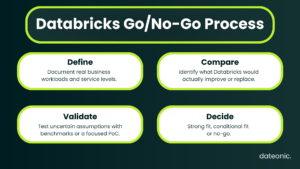
1. Define the business workloads
List the decisions, products and processes the platform must support. Name owners, consumers, service levels and acceptance evidence.
2. Document the current estate and pain
Record the platforms, pipelines, data movement, controls, operating costs and failure points that matter to those workloads. Distinguish observed problems from architectural preferences.
3. Separate present requirements from future options
Classify every AI, streaming and scale requirement as production demand, validated opportunity or aspiration. Do not give all three equal weight.
4. Identify the incremental Databricks value
State which constraints Databricks would remove, which capabilities would improve and which systems or processes could be retired. Do not count benefits that depend on changes the organization is unwilling or unable to make.
5. Estimate the complete change
Include discovery, implementation, migration, integration, training, governance, production support and recurring consumption. Compare this with the cost and risk of improving the current estate.
6. Look for disqualifiers
Test cloud and regional constraints, mandatory network patterns, workload compatibility, operating ownership, skills, governance maturity and whether the economics still work if existing platforms remain.
7. Validate only the uncertain decisions
Use a focused proof of concept or benchmark for questions that evidence can settle: representative performance, concurrency, latency, recovery, policy enforcement, integration effort and cost. Do not run an open-ended demo.
8. Make the preliminary decision explicit
Choose strong fit, conditional fit or weak fit. Record the evidence, unresolved assumptions and the person accountable for the next decision.
Organizations that pass this gate can move into a structured Databricks Discovery Phase to define scope, constraints, responsibilities and estimate inputs. Organizations that do not pass should stop, narrow the proposed use case or improve the current platform instead.
The right decision may be not to adopt Databricks
Databricks is most persuasive when its breadth reduces real fragmentation or enables production workloads that the current estate cannot support well.
Its value is weaker when breadth becomes unused optionality and the organization takes on another platform without retiring complexity elsewhere.
A defensible decision therefore asks four questions together:
- Do the workloads need the capabilities?
- Does a shared platform create measurable value?
- Can the organization operate it responsibly?
- Is that value greater than the full cost and disruption of change?
If the evidence supports all four, Databricks deserves detailed evaluation. If the answer depends on assumptions, validate them before committing. If the requirements are already met by a simpler operating model, the correct outcome may be: do not adopt Databricks.
That is not a failed platform strategy. It is a successful platform decision.