
A Databricks migration can be technically well designed and still stall because the organization around it is not ready. The platform team may be waiting for a security decision. Business users may have no time reserved for validation.
An implementation partner may be building production workloads while nobody inside the company is preparing to operate them.
These failures sit outside the architecture. They happen when authority, capacity, working processes or operating ownership exist only on paper.
A responsibility shown on a slide has little value unless a named person can make the decision, perform the work or accept the outcome when the migration reaches them.
This work normally follows Databricks discovery. Discovery may identify unclear ownership, scarce subject-matter experts or an undefined support model. Organizational readiness closes those gaps before they become delivery bottlenecks.
It also follows the platform-fit decision. If the unresolved question is whether Databricks suits the workloads, economics and intended operating model, use the Databricks Go/No-Go framework. This guide starts once the migration direction is approved or seriously planned.
What organizational readiness means in a Databricks migration
Technical readiness concerns the source estate, target architecture and migration approach. The organizational test is whether the company can supply the decisions, participation and ownership needed to execute that approach and sustain the result.
An organization is ready when it can show evidence such as:
- a sponsor who can resolve cross-functional conflicts;
- a named business owner for every migrated workload;
- reserved time from source-system experts, security, platform teams and business validators;
- agreed governance and approval paths;
- a delivery model that teams can actually follow;
- an enablement plan tied to future responsibilities;
- an accepted post-migration support and operating model;
- explicit authority for workload acceptance and legacy retirement.
Those conditions must remain true as the migration moves from one wave to the next. A readiness workshop cannot substitute for them.
Databricks’ own migration lessons reinforce this broader view.
The guidance goes beyond code conversion: it calls for active business-SME participation in user acceptance testing, executive alignment, onboarding guidance, operational practices and collaboration between customer and delivery teams.
It also describes establishing a Center of Excellence as migration execution scales.
Why a Databricks migration changes the organization, not only the platform
A migration can change who owns data, who approves access, how engineers release work, how incidents are handled, how business users validate outputs and who watches platform consumption.
The legacy operating model may have hidden these responsibilities inside a database-administration team, a managed-service contract or years of informal knowledge. Moving to Databricks brings that ambiguity into the open.
This is particularly important for governance.
Current Databricks Unity Catalog architecture guidance says that organizations should choose a governance operating model aligned with their structure and data culture because that model determines ownership, access control and policy enforcement.
The technical catalog structure comes after the organizational decision.
The same applies to operations. Monitoring can show that a job failed. It cannot decide which team responds, which business process has priority or who accepts the remaining impact.
Establish sponsorship and decision rights
The executive sponsor must be able to settle conflicts that the migration team cannot: business-as-usual work versus migration capacity, central standards versus domain requirements, or a cutover target versus unresolved acceptance evidence.
A ceremonial name on a steering-committee slide will not do that.
Readiness requires three levels of decision authority:
- Delivery decisions: Who can approve scope, sequencing and exceptions inside a migration wave?
- Control decisions: Who can approve security, privacy, access and governance outcomes?
- Business decisions: Who can accept changed outputs, authorize cutover and approve retirement of the legacy process?
A usable decision map names the people, deputies, escalation paths and expected response windows. Test it with real open issues before committing the first wave.
If a security answer, business acceptance or priority decision cannot be obtained within the delivery cadence, the route is too slow or the authority is in the wrong place. One obvious warning is a program in which every disputed decision waits for a monthly steering committee.
For detailed team composition, use Dateonic’s guide to roles for Databricks implementation. Here the test is narrower: every necessary decision and responsibility needs an accountable owner with enough authority and capacity.
Give every migrated workload a business owner
A data pipeline can pass technical tests and still produce an unacceptable business result. The migration team can reconcile row counts, but it cannot independently decide whether a changed revenue figure, risk classification or operational report is fit for use.
Every workload, or coherent workload group, needs a business owner who can:
- confirm which business process and users depend on it;
- approve business-level acceptance criteria and tolerances;
- provide or appoint subject-matter experts for validation;
- classify differences found during parallel operation;
- accept the changed output and workflow;
- authorize the retirement of the replaced report or process.
Before the wave is committed, that owner should have accepted the responsibility, reserved validation time and identified a deputy. If the person first sees the migrated output during cutover week, the workload was never genuinely ready.
Business acceptance belongs in the wave-entry criteria, not at the end of engineering.
Reserve internal capacity instead of assuming it
Partner capacity is visible in a Statement of Work. Client capacity is often treated as free and unlimited even though it may control the schedule.
A migration can require time from source-system experts, data engineers, cloud and network teams, identity administrators, security reviewers, governance leads, finance, operations and business validators. These people usually have responsibilities outside the migration.
Their participation needs to be planned at the level of actual work: named people by wave, calendar allocation, deputies, decision deadlines and confirmation from their managers. A stakeholder list with no reserved time is not capacity.
The consequences appear quickly: workshops are repeatedly rescheduled, source questions go unanswered, access requests sit idle, UAT sessions are missed and one specialist becomes the dependency for several parallel teams.
Before a wave is committed, compare its required client activities with real availability. Reduce parallel work, change sequencing or reserve more capacity when the same people are needed by several teams.
Dateonic’s Databricks implementation cost guide explains why this internal effort must also be visible in the project budget.
Prepare governance and approval processes
Governance readiness is not the existence of a policy document. It is the organization’s ability to turn a migration question into a timely, traceable decision.
For the first waves, define how the company will approve:
- data ownership and stewardship;
- access to sensitive or regulated data;
- service identities and privileged access;
- retention, deletion and audit evidence;
- production releases and emergency changes;
- exceptions to standards;
- new or changed data sharing;
- acceptance of controls before production use.
For each decision, the request path, required inputs, approver, record and escalation route should already be known. Run representative cases through that process before the migration depends on it.
An “approved in principle” design is not ready for production when identity, network or privacy teams have yet to review the actual case. If approval needs a new forum or responsibility split, establish it before workload promotion.
Unity Catalog configuration cannot compensate for an ownership model the organization has not agreed.
Align the delivery model and ways of working
A migration often introduces an agreed development and release process that differs from legacy practice. The technical design of that process belongs elsewhere.
The organizational question is whether the internal team can follow it, govern it and own it after the migration partner leaves.
Name the internal owner, the teams expected to participate, the authority for exceptions and the group responsible for maintaining the process after handover.
Then rehearse a representative change with the client team using client-controlled access and systems. If the workflow stops when a partner-owned account, tool or individual is removed, ownership has not transferred.
The Databricks Implementation Checklist covers the technical execution detail. This section asks whether the agreed way of working can continue under internal ownership.
Build an enablement and adoption plan around real responsibilities
Training attendance does not prove operational readiness. People need to demonstrate the work they will own during and after migration.
Engineers may need to build, review, release and recover workloads. Platform operators may need to respond to alerts and manage access or cost controls.
Business users may need to validate changed outputs, use a new report location or follow a different support path. Executives and governance teams need enough understanding to make informed decisions without becoming Databricks specialists.
Dateonic recommends four practical components:
- Role-based enablement: Teach only the knowledge required for a person’s future decisions and tasks.
- Learning through migrated work: Pair instruction with real pipelines, reports and operating scenarios.
- Internal champions: As a Dateonic-recommended practice, identify credible people in engineering and business domains who can reinforce the new practices and route questions.
- Continued support: Provide documentation, office hours and a clear escalation path while adoption stabilizes.
Use demonstrated performance as the measure. An engineer completes the agreed delivery process, an operator handles a simulated failure, an access approver follows the new workflow and a business user validates a representative output.
A completed course list says only that people attended.
Detailed technical upskilling belongs in the End-to-End Databricks Enablement guide. In this framework, enablement removes dependence on a few external specialists and prepares people for assigned responsibilities.
Define the post-migration operating model before cutover
Production cutover should not be the moment the organization begins discussing who owns the platform.
Before the first production workload goes live, define responsibility for:
- platform monitoring and first response;
- workload incidents and failed runs;
- business-impact assessment and communication;
- access requests and periodic reviews;
- cost visibility and escalation;
- pipeline and data-product changes;
- data-quality exceptions;
- user support;
- vendor or partner escalation;
- runbook, automation and documentation maintenance.
The answer need not be a large permanent team. In a smaller organization, one person may cover several responsibilities. Coverage, authority and escalation still have to be explicit.
Databricks’ current observability guidance connects monitoring design to workload criticality, SLAs and operational requirements and recommends documented thresholds and runbook automation.
Those technical capabilities become useful only when the organization has decided who watches them and what happens next.
Before cutover, the organization should have accepted the responsibility model, support hours, alert routes, incident procedures, cost-review ownership and escalation path. Test the path.
An assumption that the delivery partner will “support production” without a defined term, scope or transfer point leaves the operating model unfinished.
Prepare business users for validation and cutover
User acceptance testing belongs to the business, with engineering support. It cannot be reduced to a final demonstration run by the migration team.
Databricks’ migration guidance specifically calls for active business-SME participation in UAT, parallel testing and data reconciliation. It also connects executive alignment with timely SME participation and agreement on decommissioning.
For each wave, prepare:
- named business validators and an acceptance authority;
- representative scenarios, including important business-cycle events;
- agreed tolerances and a way to classify differences;
- scheduled validation time and a decision deadline;
- communication for changed reports, refresh behavior or workflows;
- a parallel-run approach where the business case requires it;
- cutover communication and a clear support route.
A completed rehearsal or UAT should leave signed decisions and classified exceptions. Technical reconciliation alone is not business acceptance.
When the evidence remains incomplete, deadline pressure should not convert uncertainty into approval. Formal controls, triggers and contingencies belong in the Databricks Migration Risk Register.
Plan knowledge transfer and partner exit
Documentation is necessary. A folder of documents, however, does not show that the client can operate the result.
Knowledge transfer should cover the platform and workloads actually delivered, the reasons behind important decisions, normal operations, failure handling, releases, access, cost review and unresolved limitations. It should begin during delivery rather than in the final week.
A practical transfer sequence is:
- The partner performs the task and explains the decision process.
- The client performs the task with support.
- The client performs it independently while the partner observes.
- Gaps become tracked actions with owners and retest dates.
Handover should be accepted only after the client team completes representative operational tasks with its own access and procedures. If production recovery, deployment or access administration still requires a partner-owned account, the transfer is incomplete.
Put these acceptance criteria in the delivery scope from the beginning. A partner can accelerate the migration and help establish the operating model; it cannot permanently substitute for internal accountability.
Assign authority for legacy retirement
A successful Databricks deployment does not retire the legacy platform. Someone must authorize that decision and make it stick.
Old reports and pipelines often remain because one user group was missed, an audit requirement is unclear, a contract has not ended or nobody wants to authorize the final shutdown.
The result is extended dual running, divided attention and users continuing to rely on the legacy platform.
Before migration execution reaches the relevant workload, identify who can authorize retirement and what evidence that person requires.
This may include completed acceptance, resolved downstream dependencies, user communication, retention decisions, an agreed fallback position and confirmation that the old platform is no longer used for an active process.
The retirement owner, criteria and decision path should be agreed before the evidence is needed. “We will decommission later” is an indefinite extension when nobody has authority, a date condition or a proof requirement.
The financial effect belongs in the Databricks migration ROI framework. Here the test is whether the organization can make and enforce the retirement decision when the evidence is available.
Organizational readiness matrix
| Readiness area | Evidence that you are ready | Warning sign | Required action |
|---|---|---|---|
| Sponsorship and decision rights | Named authorities, deputies, escalation paths and tested decision flow | Every issue waits for an infrequent steering committee | Assign decision classes and resolve representative open issues before wave commitment |
| Business ownership | Owner has accepted workload outcome, UAT and retirement responsibilities | Owner appears on a list but has reserved no time | Confirm acceptance authority, availability, deputy and sign-off criteria |
| Internal capacity | People and calendar allocation are confirmed by wave | The same SME is assumed available to several teams | Re-sequence work, reserve capacity or reduce parallelism |
| Governance and approvals | Request path, inputs, approver, evidence and escalation are known | Production approval is only “in principle” | Run representative security, access and governance decisions through the process |
| Delivery model | The client team completes a representative change through the agreed process | The process depends on partner-owned tools, credentials or people | Rehearse with client-controlled access and assign long-term process ownership |
| Enablement and adoption | Users demonstrate the tasks and decisions expected in their future role | Training completion is the only measure | Use role-based practice, migrated workloads, champions and continued support |
| Post-migration operations | Support, incidents, access, cost, workloads and user help have accepted owners | “The project team will handle it after go-live” | Establish and test the operating model before cutover |
| Business validation and cutover | Validators, scenarios, tolerances, decision authority and communication are ready | Technical tests are treated as business sign-off | Reserve UAT time, rehearse cutover decisions and record acceptance evidence |
| Knowledge transfer and partner exit | Client performs representative operational tasks independently | Documentation exists but the client cannot execute recovery or release | Use shadowing, reverse shadowing and evidence-based handover criteria |
| Legacy retirement | Named authority, criteria, dependency evidence and user communication exist | Old processes are expected to disappear on their own | Define and enforce the retirement decision gate |
Readiness gates before the migration progresses
Organizational readiness should be evaluated at decision points, not converted into another calendar timeline.
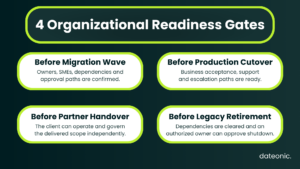
Before committing a migration wave
Proceed only when the wave has business ownership, reserved SMEs, confirmed cross-functional dependencies, decision authority and an achievable approval path. Discovery outputs should have been converted into assignments and commitments.
Before production cutover
Proceed only when business acceptance is complete enough for the defined decision, affected users have been informed, the support model is active, escalation paths have been tested and named people can authorize go, hold or rollback decisions.
Before partner handover
Proceed only when the client can operate, release, support and govern the delivered scope using its own people, access and procedures. Open gaps should have owners and an agreed support arrangement rather than being hidden inside general documentation.
Before legacy retirement
Proceed only when remaining users and dependencies are accounted for, business and control evidence is accepted, retention obligations are addressed and an authorized owner signs the retirement decision.
For duration and sequencing implications, use Dateonic’s Databricks Migration Timeline. These gates define evidence, not elapsed time.
Final takeaway
An organization is ready for a Databricks migration when delivery no longer depends on unnamed owners, unavailable SMEs, informal approvals, unplanned training or the assumption that an external team will operate the platform indefinitely.
Some unknowns will remain when work begins. What matters is that authority, capacity, acceptance and operational responsibility are explicit enough to keep organizational ambiguity off the critical path.
An experienced migration partner can accelerate architecture and delivery, help establish the operating model and transfer practical knowledge. The client still needs people who can make decisions, validate business outcomes, own production and retire the legacy process.
If you need support turning an approved migration direction into an executable, owned operating model, explore Dateonic’s Databricks Migration services.